Back in Syracuse this year, Summit 2026 brought together researchers, educators, and system leaders who share a common goal: to deepen our understanding of reading assessment and strengthen the instructional decisions that come from it. Across keynotes, panels, and workshops, one message rose above the rest—data only matters when it leads to better instruction for every learner.
The conversations pushed us to think more clearly, act with greater intention, and design systems that serve students. Below are the major insights shaping the work ahead.
Assessment: A Tool for Understanding, Not Sorting
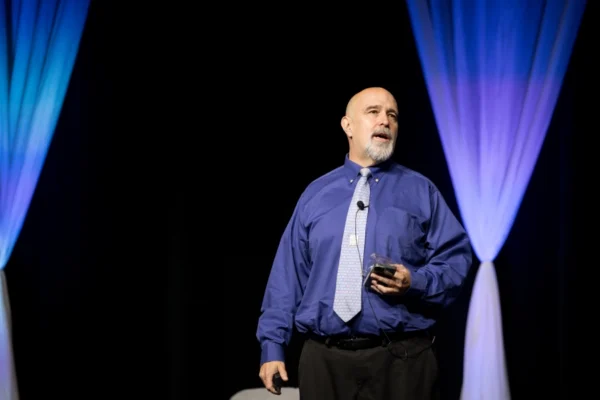
Christopher Schatschneider speaks at The Reading League Summit in Syracuse, NY.
Christopher Schatschneider opened the summit with a powerful reframing: Assessment isn’t a barrier to the science of reading, it’s the backbone of it. He reminded us that measurement and assessment are not the same thing. Measurement assigns numbers; assessment interprets those numbers so educators can make decisions.
His keynote set the tone for the summit: assessment is not about labeling students, it’s about understanding their instructional needs.
From Analysis to Action
Across sessions, speakers returned to a critical truth: analyzing data does not, on its own, change instruction.
Sarah Brown’s panel underscored the gap between reviewing data and responding to it. Many teams assume that holding data meetings guarantees next steps, but without clear protocols and decision rules, the process often stalls.

“Without good core instruction, nothing else matters.”
Matt Burns
Keeping Students at the Center
A powerful thread throughout the summit was a renewed commitment to centering the learner, not the score.
Language as a Key to Comprehension
Tiffany Hogan emphasized that language assessment is essential for understanding differences in comprehension. Words, sentences, and connected text each reveal variation in reading comprehension skills that decoding alone cannot explain.
Supporting Multilingual Learners
Lillian Durán challenged us to think more critically about validity for multilingual learners. English learners often appear at higher risk on screenings, not because of ability, but because assessments and instruction are rarely aligned to their language development. True equity comes from strength‑based interpretation, high‑quality instruction, and assessments that honor students’ home languages rather than treating multilingualism as a deficit.
Instruction as Ongoing Assessment
Multiple speakers reinforced that good instruction is assessment in motion. Opportunities to respond, explicit modeling, feedback, and intentional practice all generate actionable information.
The Summit reminded us that behind every score is a learner with a story still unfolding.
Systems That Make Data Usable
By the second day, the conversation shifted from individual assessments to the systems that surround them.
District and state leaders emphasized the need for:
“You can put a great person in a bad system, and the system wins every time.”
Kim St. Martin
Looking Ahead: From Numbers to Meaning
The charge ahead:

Attendees at The Reading League Summit in Syracuse, NY.
Summit 2026 reminded us that our task is not simply to collect data, but to connect it. Not to admire charts, but to change trajectories. And not to measure learning, but to move it forward.
The work continues, and we hope to see at future events!
The Reading League’s events bring together thousands of educators, researchers and literacy experts to engage in critical discussions surrounding the science of reading.
