By Kari Kurto, Director of Policy and Partnerships
Identifying a Need
Five and a half years ago, while I was working at the Rhode Island Department of Education, I was invited to participate in a project led by one of my literacy mentors, Dr. Maria Murray. At the time, many states were approving Tier I curricula that met review criteria, including standards alignment, usability, and evidence of effectiveness in controlled trials. Selecting a curriculum is a significant decision, and the more information decision-makers have, the stronger and more contextually aligned their choices will be.
Despite such comprehensive reviews, many curricula publishers continued to include instructional practices for language comprehension, reading comprehension, writing, and foundational skills that were not aligned with the findings from the science of reading. Thus, schools may have spent their time and money on ineffective materials that did not develop skilled readers. This was a problem.
Developing a Solution
To address this problem, Dr. Murray convened a small group of national literacy experts to develop a curricula review tool that would also identify misaligned “red flag” practices that existing review organizations were not addressing. One of the earliest communications about this work dates back to May 2020.
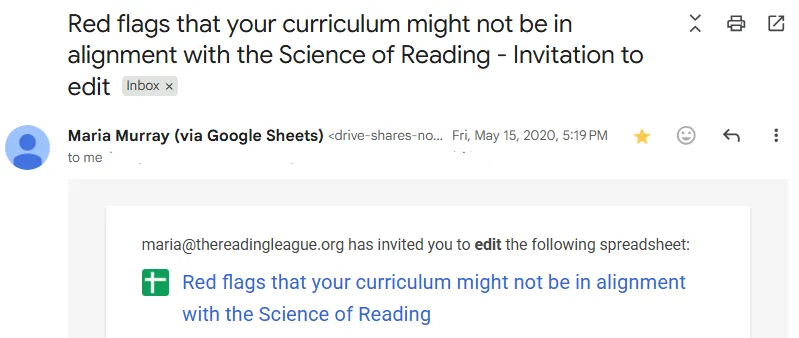
From this initial email, the Curriculum Evaluation Guidelines (CEGs) were born. This first evaluation tool has been continuously refined into the resource that is widely used today. Similar to “Nutrition Facts” labels that help consumers evaluate the healthfulness of food, the CEGs help curriculum decision-makers evaluate the effectiveness of curricula. Each of the elements in the CEGs is derived directly from scientific research on language and literacy development, making this evaluation tool the most trusted among decision-makers in schools, districts, state education agencies, and publishers.
What began as an idea on a simple spreadsheet has made a significant contribution toward evidence-aligned instruction and away from practices that consume valuable instructional time without supporting student success. The impact of The Reading League’s Curriculum Evaluation Guidelines since 2020 has been remarkable and humbling.
From Research to Practice: Curriculum Navigation Reports
As The Reading League shared the CEGs more widely, our school district partners and Reading League state chapter members, along with educators across the country, requested that we apply the guidelines to specific curricula. After more than a year of creating an objective and publisher-supported process, we launched the Curriculum Navigation Reports.
Each report summarizes findings across all available grade levels for a given curriculum and explains how the instructional practices and guidance align with the science of reading. Because materials from several grade levels are compared to the findings from the science of reading, these reports are lengthy. However, it is essential not to oversimplify instructional decisions to ensure that comprehensive instruction and assessment include everything students need to be successful. Unlike reviews focused primarily on standards alignment or knowledge-building outcomes, the Curriculum Navigation Reports examine how students are supported in developing the necessary skills to meet those outcomes. In concert with information on standards alignment and evidence of efficacy provided by other review organizations, this missing piece of the puzzle can and should be used when selecting and implementing curricula and when developing state lists.
Launching the Curriculum Evaluation Guidelines (3rd Edition)
At The Reading League, we take our responsibility to provide reliable, research-aligned tools that guide curriculum decision-making seriously. As the research base and curriculum landscape evolve, so too do the CEGs. In January 2026, we released the Curriculum Evaluation Guidelines (3rd Edition).
This edition includes several key updates:
- Improved clarity of language throughout the document
- Significant revisions to select components (marked with an asterisk), particularly in phoneme awareness, language structures, literacy knowledge, and assessment practices
- A new “Science of Learning” section to support reviewers in evaluating whether curricula provide sufficient and appropriate opportunities for student practice
Without adequate, research-aligned practice, curricula may move students forward through content without ensuring mastery of essential skills. This reality is both frustrating and inequitable for educators and learners. The “Science of Learning” section also includes areas for reviewers to indicate the degree to which the curriculum is cohesive, meaning that elements of literacy are built upon one another. Reviewers are also asked to reflect on the level of engagement and usability of the program.
We are pleased to announce that all Curriculum Navigation Reports published in 2026 will have been reviewed using the Curriculum Evaluation Guidelines (3rd Edition) to ensure the informational reports you count on are up to date and reflective of the latest research. From this point forward, the Curriculum Navigation Reports will no longer include criteria on “met” and “mostly met” to avoid oversimplifying the reports in ways that conflict with The Reading League’s mission to advance the awareness, understanding, and use of evidence-aligned reading instruction.
Comprehensive and evidence-based literacy instruction, assessment, intervention, and practice—when aligned—are the vehicle through which our students can meet the standards and follow a clear pathway to reach their dreams and goals. We have been honored to play a role in advancing the field in these endeavors, but none of it would have been possible without the exceptional instructors and bold leadership in the field.
It Takes a League.