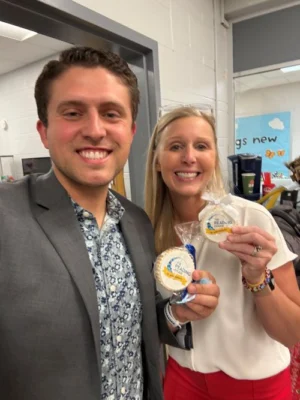
Christ Community Lutheran School in St. Louis, Missouri, is the kind of place that shapes students across their whole lives. With four campuses, a student body spanning early childhood through middle school, and a culture that lifts its own people up from within, CCLS is defined, above all else, by its people.
Principal Rachel Klug first attended CCLS as a student from preschool through eighth grade, then returned as a teacher, and is now in her third year as principal. Assistant Principal Jesse Schultz arrived as a teacher, fell in love with the school, and is stepping into the role of middle school principal this fall. Both of them will tell you the same thing: CCLS is home.
“We say we are Christ Community Lutheran School — in that order. Our community makes us special.”
A Rabbit Hole That Changed Everything
Rachel’s path to The Reading League started the way a lot of good things do—with a podcast. While listening to a Melissa and Lori Love Literacy episode, she heard The Reading League mentioned. She Googled it. Then she fell down what she calls “a huge literacy rabbit hole” on the TRL website, and on a whim, submitted a contact form asking what TRL could offer their school.
What followed was a conversation with members of The Reading League’s Professional Learning team to better understand CCLS’s context and needs. From there, a partnership took shape that made it possible for the district to begin professional learning in a way that was both timely and financially accessible. That collaboration hasn’t stopped since, with ongoing support tailored to the district’s goals.
“I was a new administrator who knew we needed to make some changes, but wasn’t quite sure what those changes needed to be.”
Building From the Top Down
From the beginning, Rachel and Jesse understood something research confirms: Lasting instructional change has to be led from the top. They committed to learning alongside their teachers rather than just directing them. Through weekly coaching sessions with TRL, they worked on the systems and structures that would make better teaching possible. They made sure it was something they could build, measure, and sustain.
One of the most tangible results was a new master schedule at the elementary campus. This schedule plays a critical role in how time is allocated and directly impacts teaching and learning. It ensures leaders have clear visibility into when instruction is happening so they can support teachers, conduct observations, and ensure core instruction is appropriately prioritized. A well-designed schedule promotes equity by ensuring all students have consistent access to instruction, intervention, and enrichment regardless of classroom or team assignment. It also intentionally embeds intervention blocks so students can receive additional support without missing core instruction, making that support more effective and less disruptive. It quickly became one of the year’s most meaningful changes.
Rachel also formed a literacy implementation team of teachers who volunteer to go deeper, bring ideas to their peers, and build momentum from within. The goal was to shift from admin-driven decisions to a culture where the whole staff owns the work together.
The Moments That Stay With You
Reading data matters at CCLS in a different way now. Prior to this year, the school tracked student progress through Northwest Evaluation Association (NWEA), a nationally normed assessment, but the addition of Dynamic Indicators of Basic Early Literacy Skills (DIBELS) has created a more aligned and comprehensive approach to reading data across the school and has allowed staff to develop a clearer understanding of student reading development, instructional needs, and progress monitoring.
“That’s not a data point. That’s just something you can see success through.”
There are classrooms now where students track their own fluency scores after every session. Where walkthroughs reveal every student engaged, every mind active. Where, as Jesse put it, “learning is no longer passive.”
But it’s the stories that Rachel and Jesse come back to.
A student who had been struggling with reading worked with a TRL professional learning specialist during an implementation support visit. Months later, the specialist returned to CCLS and watched that same child work through a lesson with his teacher. He was fully engaged and knew exactly what to do. The shift was so noticeable that when the student’s college-age sister was visiting, she exclaimed, “He can read now!”
What Surprised Them Most
Both Rachel and Jesse expected some resistance when they introduced major instructional changes. What they got instead was a staff who leaned in. The teachers wanted to learn alongside leadership and embraced the shift.
And through all of it — the coaching, the walkthroughs, the curriculum research — Jesse keeps coming back to one word: fun. Not easy. But genuinely and surprisingly fun.
“The people at The Reading League made an effort to get to know us, understand the full picture of our school, and just made this learning process fun.”
Next year, CCLS moves forward with an evidence-aligned curriculum that gives its teachers the tools to build on everything they’ve learned. The work isn’t finished. But the foundation is real, and the community is all-in.
We’re grateful to Rachel, Jesse, and everyone at CCLS for trusting us with this journey and for showing what it looks like when a school commits to getting reading right, together.
Your stories help bring our mission to life. If you’d like to share how The Reading League has supported your work, students, or community, we’d love to hear from you.
That wraps up our Partner Appreciation Month series. Thank you to Pleasant Rowland, Jeff Knauss, Stephanie Dimmit, and the entire CCLS community for the ways you make this work possible and meaningful.