The Compass School: A Director and Literacy Coach Share Their Literacy Transformation
Brandee Lapisky is the director of The Compass School, a charter school in Kingston, Rhode Island serving 217 students in Grades K-8. Although historically a high performing charter, administrators recognized that students’ literacy achievement had plateaued. In order to see students grow as readers and writers, change was needed. The Compass School’s literacy journey began in the spring of 2020 as a result of three major outside contributing factors:
- The Right to Read Act was passed in Rhode Island in July 2019. The law mandates that RI educators enroll in training approved by the Rhode Island Department of Education (RIDE) to exhibit either proficiency or awareness of the knowledge and practices of the science of reading and Structured Literacy. The law requires local educational agencies (LEAs) to provide professional learning for educators to support these requirements.
- LEAs were tasked with selecting ELA curricular materials from a pre-approved RIDE list.
- The Compass School was awarded a $310,790 Comprehensive Literacy State Development grant that enabled it to hire Heather Ballantine as its literacy coach to support all literacy efforts.
Here Brandee Lapisky and Heather Ballantine share their journey spanning from spring 2020 to February 2023 in hopes that doing so may help educators entering the initial stages of district level literacy transformation shift to the implementation of scientifically validated practices. The overview of their work to transform literacy practices is presented here according to the four main focus areas that took place during the same time period: The Big Picture, Curriculum Adoption, Professional Development, and Sustainability.
FOCUS AREA: The Big Picture
The Starting Line: Spring and Summer 2020
At the directive of RIDE, literacy consultants from Hill for Literacy surveyed The Compass School’s staff in the spring of 2020 to gauge current levels of knowledge and implementation of evidence-based literacy practices. They shared their findings that the district needed to conduct major literacy shifts, including training all staff in evidence-based assessment and instructional practices, revamping MTSS structures and systems (including RTI), and adopting a science-aligned ELA curriculum. Although curriculum selection was expected during the 2020-2021 school year, there had been plans to wait a year before hiring a literacy coach. However, RIDE recommended prioritizing the hiring of a coach to participate in and lead the selection process. Heather Ballantine was hired in the summer of 2020, and Hill For Literacy led a small, diverse group of school staff through the drafting of a Literacy Action Plan. Their draft mapped out clear goals with action steps in five areas: leadership, assessment, instruction, professional learning, and family engagement. Once the draft was started, Ballantine finished it and sent it to RIDE and Hill for Literacy for final review. The plan was approved and remains essential to this day in guiding the work.
Year 1 (2020-2021): Work on Building the Foundation, Logistics, & Relationships
A coach is a thought partner for teachers and administrators and works alongside them to set and accomplish student-focused goals. Teachers at The Compass School had never worked with a coach. To set the stage for Heather Ballantine to join the staff, Lapisky and Ballantine planned opportunities to establish trust and build relationships with teachers. Ballantine was given time during staff meetings to share her background and explain her role. Hill for Literacy’s survey gave a clear depiction of the district’s current state and areas for growth, which she used to conduct walk-throughs, observations, surveys, and interviews to learn specifi cs regarding educators’ knowledge of Structured Literacy, current practices, backgrounds, experiences, philosophies, and personal intentions for this work.
Ballantine and Lapisky understood they shared a common purpose: to empower and serve the teachers. They launched year one by meeting for 30 minutes weekly to develop systems and structures related to MTSS and professional development related to the ELA Grades 3-8 curriculum adoption and the science of reading. They also drafted a literacy vision and a six-year outline of yearly literacy goals (knowing the pacing would most likely change). This outline set a path to the vision and serves as a reminder that a “bucket fi lls drop by drop.” All staff meetings, observations, walk-throughs, evaluations, coaching, and PD would align to the yearly literacy goals.
First Draft of Yearly Literacy Goals Outline
- Year 1: Building the Foundation – Logistics and Relationships
- Year 2: Word Recognition & Spelling
- Year 3: Fluency
- Year 4: Vocabulary & Morphology
- Year 5: Language Comprehension & Writing
- Year 6: Writing Process
Ballantine and Lapisky created a document outlining staff members’ roles and responsibilities related to literacy to guide PD and build accountability. The document answers questions such as, “Who delivers intervention in Tiers 2 and 3? Who is responsible for updating the Literacy Action Plan? Who administers and analyzes screening and diagnostic literacy assessments?” (Refer to the document at https://rootliteracydesign.com/downloads/ for answers to these questions.) At the end of the year, they shared it with the staff for feedback and announced the establishment of a literacy coordinator team to start the following school year. One teacher from each grade level and one special educator from the district formed this team.
Year 2 (2021-2022): Work on Strengthening MTSS
The literacy coordinator teams began meeting twice a month. The fi rst thing they did was establish their purpose and mission: Our team exists to help ensure all students learn to read and write. Our mission is to educate ourselves and others, to develop common language, and to grow evidence-based literacy practices within all settings. Our team aspires to build a school-wide culture for literacy and to support/build the systems and structures that allow this work to happen. Along with maintaining the Literacy Action Plan, they serve as a liaison within their grade level meetings and help strengthen MTSS structures within the district. Ballantine facilitates this team and serves as the communicator between this team and leadership. Lapisky is not a member, but she attended the first meeting to show her support and to clarify the purpose of the team; she continues to attend as needed.
As a result of collaboration among many staff members, the district created assessment flow charts for each grade level, and all teachers from every grade administered diagnostic literacy assessments for the first time. Each grade level participated in three data days (fall, winter, spring), during which teams analyzed diagnostic assessment data, looked for student trends and needs, formed tiered instructional groups and goals, reviewed materials, brainstormed instructional strategies, and determined future coaching support. Lapisky knocked down barriers by maintaining substitute coverage and providing funding for instructional materials, and Ballantine provided coaching to make these goals achievable. When starting this work, the teachers were often shocked and overwhelmed by the diverse needs of their students. It was important to make time for them to discuss what they were coming to understand, without blame or judgment upon others or themselves. Ballantine and Lapisky continuously reminded them that change takes time, and that when student growth happens, they should celebrate!
Year 3 (2022-2023): Work on Implementation and Accountability
The third year’s focus was on sustaining the implementation of the new curricula and establishing accountability. This is described in more detail in the following focus area section on curriculum adoption.
FOCUS AREA: Curriculum Adoption
Year 1 (2020-2021): Work on Grades 3-8 Curriculum Selection
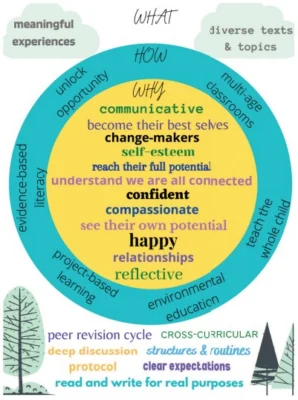
The Comprehensive Literacy State Department grant was allotted to Grades 6-8 and came with a year-end curriculum selection deadline, which is why curriculum selection began with Grades 3-8 and not K-2. The Compass School drew motivation for this work from Simon Sinek, inspirational speaker and author of Start with the Why (2011). Sinek conceptualized a Golden Circle so that an organization’s Why, How, and What are clear and serve to inspire cooperation, trust, and change. The Compass School’s Golden Circle (see Figure 1) would guide them in their first professional development session for Grades 3-8 curriculum selection work, first focusing on their Why. The How and What sections of the circle were built with staff at a PD session later that year. They saw the science of reading as what would provide them with success in achieving their Why and How, and curricula and instructional practices based on the science of reading as their What. No matter how skilled their educators, they were not trained in writing curriculum for maximum effectiveness. Their expertise is in the delivery and in expanding on the existing curriculum. Ballantine and Lapisky repeatedly emphasized the following messages to teachers: teachers teach students, not curricula, and there’s no perfect curriculum out there. Ultimately, a curriculum from Rhode Island Department of Education’s pre-approved list of curricula aligned to the science of reading and Structured Literacy practices was chosen. Ballantine had analyzed top contenders that had “the strongest bones to build from.” Teachers piloted one unit from the top two contenders, and in the end, the curriculum they chose was the one they thought best aligned with The Compass School’s Golden Circle.
Figure 1
The Compass School’s Golden Circle
Year 2 (2021-2022): Work on Grades K-2 Curriculum Selection & Grades 3-8 Curriculum Implementation
Grades 3-8 had anchored their curriculum selection work using The Compass School’s Golden Circle. Lapisky knew K-2 teachers also needed a clear literacy anchor to guide their selection process. Using RIDE’s rubric (see https://www.ride.ri.gov/Portals/0/Uploads/Documents/Instruction-and-Assessment-World-ClassStandards/HQCM-Bundle/HQCM_FoundationalSkillsReviewTool.pdf), she guided the teachers in identifying literacy areas where they most needed curriculum materials. The teachers identified phonological and phonemic awareness, a scope and sequence of foundational literacy skills, decodable texts aligned to the scope and sequence, diverse complex texts, and encoding as priorities. During monthly staff meetings, Ballantine and Lapisky worked with teachers to analyze samples of curricula approved by RIDE to determine alignment to evidence-based literacy practices. One curriculum was favored and a neighboring district that was implementing it allowed them to visit and observe. While K-2 teachers worked on their curriculum selection, teachers in Grades 3-8 worked toward the curriculum goals they had developed the previous year. Ballantine and Lapisky divided their time at staff meetings to meet with and support teachers as needed.
Year 3 (2022-2023): Work on Curriculum Implementation Support
To continuously support teachers in implementing the new curricula, Ballantine and Lapisky devised a schedule. They dedicated two staff meetings per month to curriculum work with the staff based on their needs. Ballantine coached each K-2 teacher individually, and Lapisky was available to meet with them as well. Teachers in Grades 3-8 continued to collaborate with one another and reached out for support when needed.
FOCUS AREA: Professional Development
Year 1 (2020-2021): LETRS Training and Professional Development on Assessment
Classroom and special education teachers in Grades K-2 began professional development in the science of reading and Structured Literacy via LETRS training in 2020, and their professional development remained aligned to that work. Ballantine and Lapisky knew they also needed to purposefully plan opportunities to gain teacher buy-in to the science of reading in Grades 3-8, especially because a curriculum had to be selected by the end of the year. It was important that teachers had materials and resources aligned to what they were going to be asked to do. Ballantine spent September and early October assessing students in Grades 7-8 in preparation for her first science of reading professional development in October. She had three hours to help teachers understand why a change in teaching practice was necessary. She hoped to gain teachers’ understanding that current practices and materials were not best supporting students. During this virtual training, Ballantine began by asking a question that was met with complete silence. After several seconds, the director of student services, spoke up and said, “I actually don’t know this either, so I’m learning it with all of you right now.” Lapisky immediately stated, “Same here. I’m learning with all of you right now.” This broke the ice. Some of the teachers started laughing, and everyone participated after that. Leadership forges the path by being honest and transparent; authentically participating in professional development and learning with staff is a great way to do this. Lapisky and the director of student services publicly recognized that they are not literacy experts and don’t need to be. They partnered with Ballantine and learned with their team.
After the October professional development, multiple teachers approached Ballantine hoping she could help them assess their students’ reading abilities. In response to teachers wanting more professional development to learn about the diagnostic assessments, Ballantine led a second, three-hour session in spring of 2021 on the purposes and uses of screeners and diagnostic literacy assessments. She began the work of coaching teachers in decoding and encoding assessments, including real and nonsense word reading, letter-sound correspondence, alphabet knowledge, letter formation, phonemic awareness, and reading and spelling high frequency words. Due to the high level of teacher buy-in, Lapisky offered to pay teachers who wished to attend an optional 30-hour training over the summer led by Ballantine. One third of Compass teachers (including two of fi ve teachers in LETRS training) attended in order to continue to learn about assessment and Structured Literacy instruction in word recognition and spelling.
Years 2 and 3 (2021-2023): Teacher Proficiency Training
For the first time, teachers within every grade level began delivering Structured Literacy instruction in word recognition and spelling aligned to a foundational literacy skills scope and sequence, with Ballantine coaching. K-2 teachers continued LETRS training and were given five additional professional development days to complete that training by the end of the school year. Along with being the literacy coach at The Compass School, Ballantine is the founding partner of Root Literacy Design, through which she provides training, coaching, and consulting support to schools. In the spring of 2022, Ballantine learned that her RIDE application to be a proficiency provider for the Right to Read Act was approved. All teachers in Grades 3-8 in need of proficiency training chose her as their provider and continued learning with her. The training consisted of 72 hours of in-person classes broken into two sections. The first section focused on word recognition and spelling, and the second section focused on fluency, vocabulary, morphology, language comprehension, and writing. Lapisky and Ballantine made plans for Ballantine to offer a “Compass only” cohort for the first section during the summer of 2022.
By the start of the 2022-2023 school year, teachers who needed to meet the proficiency requirement of the Right to Read Act had completed 36 hours of training with Ballantine. Educators required to complete awareness training for the Right to Read Act began their 10-hour online coursework during the summer of 2022. They are expected to complete it by the end of the 2023 school year. As students’ literacy achievement grew, so did teacher buy-in. Teacher assistants (who hold at least a bachelor’s degree) as well as substitute teachers expressed interest in going through training. In response, a second cohort for the first section of Ballantine’s training took place on six Saturdays from October of 2022 to February of 2023.
FOCUS AREA: Sustainability
Transforming instruction occurs in two main phases: knowledge building, then guided implementation. Teachers in the district embarked upon the two paths of science of reading and Structured Literacy training: LETRS and Root Literacy Design. Table 1 reflects the types of professional development and hours associated with each type for a typical staff member participating in The Compass School’s literacy transformation on the proficiency track of the Right to Read Act. Note that this is retrospective data and not necessarily indicative of our process for staff moving forward now that the program is established.
Table 1
Types and Number of Hours of Professional Development
| Year of Implementation |
Year 1 (2020-2021) |
Year 2 (2021-2022) |
Year 3 (2022-2023) |
3 Year Summary Data |
|---|---|---|---|---|
| Training | 0 | 48 hours | 48 hours | 96 hours |
| Staff Meetings/ Professional Development |
6 hours | 20 hours (2 x per month, 1 hour each) |
10 hours (1 x per month, 1 hour each) |
36 hours |
| Coaching (per teacher coached) |
0 | 68 hours (2 hrs per week x 34 weeks) |
34 hours (1 hr per week x 34 weeks) |
102 hours |
| Total Hours (per person) |
6 | 136 | 92 | 234 hours per educator |
*To lay the groundwork for effective coaching, in Year 1 the coach prioritized information gathering and relationship building. Twenty fi ve percent of the coach’s schedule was spent in classrooms during this period; however, it was informal in order to create a natural access point for a more formal coaching approach in Years 2 and 3.
Years 1 and 2 (2020-2022): Accessible Materials and Resources
Sustainable structures also include creating central spaces for educators to access materials. A “Literacy Resources” folder in the district’s Google Drive was created to house diagnostic assessments and instructional materials. An “RTI Resources & Groups” folder was created to house assessment flowcharts and other documents for data analysis and tiered instructional planning. The teachers’ room was reconfigured to include bookshelves to house literacy resources and office supplies to allow for planning. All teachers received new instructional materials; Ballantine modeled and guided them in learning how to use them to instruct students in foundational literacy skills.
Year 3 (2022-2023): Observation and Feedback for Accountability
Following Jim Knight’s lead from his 2001 book titled Unmistakable Impact: A Partnership Approach for Dramatically Improving Instruction, Ballantine and Lapisky outlined the following clear literacy target goal to provide a purpose for all work done throughout the school year: I can provide Structured Literacy instruction in word recognition and spelling. All professional development, staff meetings, and coaching align to the target goal. This remains true even when Ballantine is supporting K-2 teachers with implementing their curriculum.
Because all staff are trained or finishing training in word recognition and spelling, Ballantine and Lapisky developed an observation and feedback tool to build district level accountability. Along with the director of student services, they observed three teachers willing to partner with them to test the tool’s effectiveness. After multiple observations and rounds of revision, which included feedback from the teachers, the tool was announced to all teachers. In order to communicate the whole school’s prioritization of their literacy progress, Lapisky required all teachers to tie one of their three formal observations to the science of reading and Structured Literacy. This was the case for all content areas in all grade levels.
To build sustainability and continue to support implementation, Ballantine began recording herself and teachers. She created a Structured Literacy teaching library on YouTube through her company’s channel. Lapisky kept literacy at the forefront by consistently messaging staff to “keep the course,” highlighting teachers for their progress, and leading a staff meeting in which educators discussed and reflected upon Emily Hanford’s Sold a Story (Hanford, 2022).
Achievement Outcomes
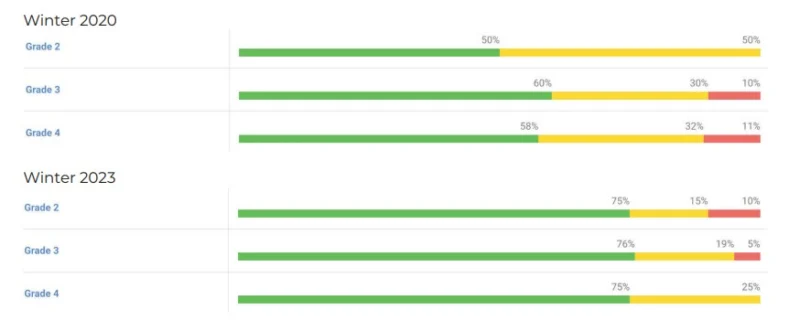
The three cohorts represented in the data charts (Grades 2-4) were hard hit by the pandemic. They were in preschool through Grade 1 when the district was virtual in spring 2020, a critical time in their learning to read journey. In spite of this, educators are seeing the best collective screener performance at the midyear mark that they have ever seen. The winter 2020 chart in Figure 2 represents pre-literacy reform status. The range was 50-60% on grade level for reading for Grades 2-4, compared to the winter 2023 chart showing 75-76% on grade level. Since implementing Structured Literacy practices, not only has the pandemic gap in these grade levels closed, but educators are seeing an average of 20% growth from pre-pandemic performance.
Figure 2
Literacy Reform Data Comparing Winter 2020 to Winter 2023
Next Steps
Teachers remain hungry for more professional development. Ballantine and Lapisky mapped out summer 2023 sessions for teachers to complete the second section of Root Literacy Design training. They are currently partnering with teachers to finalize the first draft of an observation and feedback tool for next year’s target goal: I can provide Structured Literacy instruction in fluency. The literacy coordinators are working on building pathways to build families’ knowledge and engagement regarding home literacy practices.
We are extremely proud of the commitment of our teachers and the incredible progress we made in just a few years’ time. Although we are a small charter school, we believe that the approach we took to transforming our practices to align with the science of reading can be applied to schools and districts of any size. Building teachers’ professional knowledge and providing them with resources aligned with the science of reading, in conjunction with ongoing support and accountability, are a recipe for success.
References
- Hanford, E. (Host). (2022, October 20). Sold a Story: The Problem (No. 1) [Audio podcast episode]. APM Reports. https://features.apmreports.org/sold-a-story/
- Knight, J. (2011). Unmistakable impact: A partnership approach for dramatically improving instruction. Corwin.
- Sinek, S. (2011). Start with why: How great leaders inspire everyone to take action. Portfolio.
Written by: Heather Ballantine and Brandee Lapisky
Content Disclaimer:
The Reading League Blog features a range of perspectives intended to inform and support educators, leaders, and advocates. The views expressed are those of the authors and do not necessarily reflect the positions or policies of The Reading League.