Education is a continuous journey of growth and evolution, and as educators, our primary goal is to provide the best learning experience for our students. Over the years, our Title 1 school embraced the balanced literacy approach. While it served us well, we recognized the need to adapt and respond to emerging research and best practices. Thus, we decided to embark on a transformative journey with the Science of Reading research as our foundation. Over the past two years, we have seen this instructional shift yield remarkable positive results, not only in our students’ reading abilities but also in their overall academic performance and confidence.
What is Balanced Literacy?
Historically, balanced literacy has been defined in many ways. In our school, it meant a greater focus on comprehension standards and time spent in authentic reading and writing. While this approach held certain advantages, it also had its limitations. For our school, “balanced” didn’t mean that all five pillars of reading, as identified by the National Reading Panel, were represented in our daily teaching. In fact, instruction in the foundational pillars of phonemic awareness and phonics was sporadic, at best. Many students struggled to decode unfamiliar words, leading to comprehension issues. As our understanding of literacy research evolved, it became evident that a more systematic and evidence-based approach to reading instruction was essential so every student could become a proficient reader.
How did your school go about embracing the Science of Reading?
As we analyzed our data, we had to face the reality that we had more students performing below grade level in reading than we had resources available for intervention. Running records showed that students used “meaning” and “structure” but did not use “visual” cues to support their reading. This deficit in graphophonic cues also appeared in spelling inventories. Our students didn’t have the knowledge of how words work down to the letter/sound level evidenced in both reading and writing. Even as our population shifted with rezonings, our data remained consistentmany students were unable to decode well enough to comprehend. Change was on the menu. Our Literacy Team was charged with making changes to our instructional model across all grade levels. The Science of Reading is founded on evidence-based research and emphasizes the importance of phonemic awareness, phonics, vocabulary, fluency, and comprehension. It recognizes that reading is not an innate skill but a complex process that requires explicit instruction in the foundational components of reading. After conducting our own research, we knew these changes were just what our students needed. Understanding the science behind how the brain learns to read, our educators embraced this approach with enthusiasm and an eagerness to provide the best possible education for our students.
What professional development or teacher training did you provide?
Transitioning from the balanced literacy approach to a Science of Reading focus required significant changes in our teaching methodologies. As a Palmetto Literacy Project Tier 2 school, where 33% to 49% of third graders scored Does Not Meet on SCReady ELA, we were provided LETRS training for our K-3 teachers. However, knowing that many of our upper-grade students also struggled with decoding, our school made the decision to train ALL teachers- K-5, resource, MLL, speech, school psychologist, and interventionists using LETRS. This not only provided us a common language and knowledge base but ensured instructional continuity across grades and settings. Weekly meetings centered around LETRS and SOR best practices provided our educators with comprehensive and ongoing professional development to ensure they had the necessary tools and knowledge to implement this approach effectively.
What evidence-based strategies did you use, and what challenges did your school face?
We set out to implement Science of Reading strategies in our classrooms. Knowing that this instruction had the potential to change lives, we placed high value on the explicit teaching of phonemic awareness skills and phonics for the first time. Phonemic awareness activities became a regular part of our early education curriculum and yielded quick gains. Across all grades, we began systematic phonics instruction to teach letter-sound correspondence, blending, and decoding skills. High-quality, decodable texts were introduced to reinforce these skills, allowing students to practice reading with success and build their confidence. However, these changes came with challenges. One of the biggest was the mindset shift-understanding we had to let go of “what we’ve always done” to embrace new understandings of research and how the brain learns to read. As a former Reading Recovery teacher, our literacy coach struggled with this shift for many years. However, the “numbers didn’t lie.” Continuing to do what we had always done did not make sense. “I had to alter my thinking about how students learn to read and realized quickly that the missing piece had been evident all along.” This missing piece was the explicit PA and phonics instruction that informs authentic reading and writing. Embracing this mindset meant doing something different than other schools in our district. This looked like implementing different curriculums and using different materials than our peers for phonemic awareness and phonics. Finding our own resources, conducting our own professional development, and securing our own materials took time and effort. However, it also presented opportunities for us to engage in dialogue with the district office about our thinking.
What progress monitoring methods did you use?
Over these last two years of doing something different, we have closely monitored our students’ progress. Universal screeners and regular assessments helped us continuously identify areas that needed further improvement and allowed us to make data-driven instructional decisions. It was heartening to witness struggling readers make remarkable strides, catching up to their peers and fostering a positive learning environment. Listed below are the tools we used for progress monitoring.
| Progress Monitoring Tool | Who? | When? |
|---|---|---|
| Heggerty Assessments | K-2 | 3x/year |
| Fastbridge | K-2 | 3x/year (Fall, Winter, Spring) |
| Running Records (cold reads) |
K-5 | Monthly |
| Spelling Inventory | K-5 | 3x/year |
How did the implementation of Science of Reading strategies affect student data?
Historically, our data did not match what we knew our students were capable of. As uncomfortable as the challenges mentioned above were for some, the outcomes have far exceeded our hopes and expectations! For many, seeing was believing. The positive results of our instructional shifts were truly inspiring. Not only did our students’ reading abilities improve significantly, but their overall academic performance also saw positive effects. By mastering the foundational skills of reading, students gained confidence in their abilities, which translated into improved participation and engagement in all subjects. Furthermore, we observed reduced frustration levels among struggling readers, leading to a more positive attitude toward learning. Specifically, as a TSI school, our multilingual population had been identified for targeted assistance. After implementing changes in instruction, we no longer have multi-lingual as an area for targeted assistance. The information presented below tells our story better than we ever could!
Percent of Students At or Above the 30% (according to FastBridge data)
| Grade | Fastbridge Assessment Given | Spring 2022 | Spring 2023 |
|---|---|---|---|
| K | Early Reading English | 54% | 74% |
| 1 | Early Reading English | 62% | 82% |
| 2 | aReading | 22% | 53% |
| 2 | AUTOreading | 37% | 67% |
Conclusion
Transitioning from a balanced literacy approach to a Science of Reading research focus has been a transformative and rewarding experience for our school. By embracing evidence-based practices, providing comprehensive teacher training, and closely monitoring progress, we have witnessed remarkable positive results. Our students have become more proficient readers, confident learners, and enthusiastic participants in their education. As we continue to evolve and learn, we remain committed to providing the best possible education for our students, equipping them with the skills they need to succeed academically and in life. This year, we are continuing our journey with year two of LETRS training. In addition, we are implementing sound walls in K-2, a new phonics curriculum in K-3, and a new multisyllabic word/vocabulary curriculum in our upper grades.
Updates as of October 10, 2023
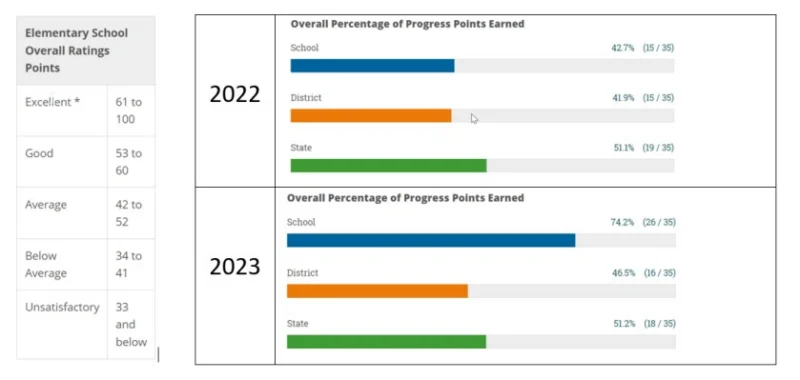
South Carolina released school report cards on October 10, 2023. Ebinport Elementary received a total of 60 out of 100 points- an increase of 13 points from the previous year, giving us an overall rating of “Good.” Twenty-six of the 60 points earned were in the area of Student Progress. The charts below show Ebinport’s 2022 and 2023 data.
Contacts:
- Rhonda Kelsey, Principal rkelsey@rhmail.org
- Marco Vaughan, Literacy Coach mvaughan@rhmail.org
Content Disclaimer:
The Reading League Blog features a range of perspectives intended to inform and support educators, leaders, and advocates. The views expressed are those of the authors and do not necessarily reflect the positions or policies of The Reading League.