TABLE OF CONTENTS
Written by: Elisabeth Lamoureaux, Professional Learning Director – Leadership & Implementation
How leaders can design schedules that protect grade-level learning, align support to student needs, and create the conditions for evidence-aligned literacy instruction.
It’s 9:12 on a Tuesday morning. Marcus, a third grader, is following along as his teacher reads a portion of the class’s grade-level text aloud.
The teacher pauses and asks students to turn and talk about the word “yield.” In this passage, does “yield” mean “to produce” or “to give way”? What clues from the text helped you decide?
Marcus leans toward his partner just as there’s a knock at the door.
It’s time for Marcus to leave for intervention.
He tucks his half-finished work into his folder and heads down the hall to the support he needs.
His partner turns to someone else, and the conversation continues without him.
The problem isn’t the intervention. It’s when it happens.
Nobody planned it this way, exactly. Marcus receives intervention because he needs additional support with foundational reading skills. At the same time, his core literacy instruction is also where he builds knowledge, engages with complex text, develops vocabulary, and participates in rich discussions that help him grow as a reader.
He needs both.
You can’t pull time from one to fund the other. That’s not catching him up. It’s trading one opportunity gap for another.
Marcus isn’t unique. Multiply his experience across every intervention pull-out in every school, and you begin to see a pattern that many schools quietly live with every day. The students who need both Tier 1 and intervention are often the ones with the least access to each. Guidance from the Louisiana Department of Education documents this same pattern across schools: when a student is identified as needing extra help, that support is often carved out of core reading and math time rather than added alongside it. The instinct behind it is usually good, using the only open slot available, but the effect is the opposite of what the intervention was meant to do.
This scene repeats itself in schools everywhere. And it points to a question every leadership team should ask honestly:
Does our schedule make evidence-aligned literacy instruction easier or harder to deliver every day?
Walk into many schools, and you’ll find a binder full of individual classroom schedules. Each teacher has thoughtfully planned literacy instruction, transitions, and small-group time. Yet those schedules were often built independently—a collection of classroom plans rather than one coordinated instructional system. The consequences are familiar:
- A reading specialist pulls students during core literacy instruction because there simply isn’t another time available.
- Intervention groups stay the same for months because adjusting them feels impossible.
- Teachers struggle to find protected time to review student data together.
- Students miss core instruction, science, social studies, or electives to receive additional reading support.
None of this reflects a lack of commitment or expertise.
More often, it reflects a scheduling system that evolved over time rather than one intentionally designed to support literacy.
Researchers at Stanford’s Accelerator for Learning describe the master schedule as a reflection of how leaders allocate three of their scarcest resources: time, money, and people. Ultimately, those decisions shape the educational opportunities available to every student.
“It’s literally the map of what we do.” — School leader interviewed by Stanford’s Accelerator for Learning
When the map is off, it shows up immediately in students pulled from instruction, in specialists stretched too thin, and in intervention groups that never change. When the map works, ironically, no one notices it at all. The strongest literacy schedules are not built by simply finding a place for intervention. They are designed around three leadership priorities:
- protecting Tier 1
- coordinating expertise
- protecting every instructional minute
Scheduling Is Implementation Infrastructure, Not a Calendar
When schools struggle to implement evidence-aligned literacy instruction, the conversation usually turns to curriculum, assessments, intervention programs, or professional learning. Those are all essential components of a comprehensive literacy system. Yet one of the most powerful implementation levers is often treated as a logistical detail rather than a leadership decision: the master schedule.
Implementation science offers a useful lens here. Effective practices don’t sustain themselves through willpower or good intentions. They sustain themselves through organizational systems that make evidence-aligned instruction the easiest, most supported way of working.
A curriculum can be evidence-aligned, and a professional learning plan can be excellent, yet a school can still struggle to see results if the building’s daily operating system routinely interrupts, delays, or displaces the instruction those investments were meant to protect. The schedule is not simply the backdrop to implementation. It is one of the primary implementation drivers. When well-designed, evidence-aligned instruction becomes easier to deliver consistently. When it is designed poorly, even the best curriculum and strongest professional learning struggle to overcome the barriers it creates.
David James and Nate Levenson argue that strategic scheduling is more than arranging classes or balancing staffing. It is a leadership process for intentionally organizing the school day around instructional priorities (James & Levenson, It’s Time for Strategic Scheduling). Viewed this way, the master schedule becomes more than a reflection of priorities. It is one of the ways leaders turn those priorities into daily practice.
Rather than asking, “How do we fit intervention into our current schedule?”, leaders might ask, “How should our schedule change to support the literacy instruction we want every student to receive?” That shift moves scheduling from an exercise in logistics to an exercise in systems design.
Three Layers of Scheduling
Thinking about scheduling through a single lens often leads leaders to search for a single solution, usually a WIN block or an intervention period. In reality, effective literacy schedules operate as an interconnected system. Leadership teams need to consider three layers at once: when literacy happens, how expertise is coordinated, and how instructional time is protected within the block.
- The Master Schedule: when literacy happens and how time is allocated across the day.
- The Collaboration & Coordination Schedule: how classroom teachers, specialists, interventionists, and grade-level teams work together within that time.
- The Instructional Schedule: how every minute within the literacy block is actually used.
Most scheduling conversations stop at layer one. Layers two and three are where implementation either takes hold or quietly erodes.
Five Signs Your Schedule Is Working Against Your Literacy Goals
- Students routinely leave core literacy instruction for intervention, enrichment, or specials because there’s no other time in the day.
- Intervention groups haven’t changed in months, even though progress-monitoring data have.
- Specialists and interventionists are scheduled around availability rather than student needs.
- Teachers have no protected time to review literacy data together; collaboration happens informally, if at all.
- The schedule reflects historical data and routines more than current student needs.
If any of these sound familiar, the next three sections will help you see where to start in the schedule.
Layer 1: Protect Tier 1, Then Build Around It
Marcus’s story is really a Layer 1 problem. High-quality Tier 1 instruction is the foundation of every effective literacy system, and it has to be protected as its own non-negotiable, not treated as a flexible pool of minutes to draw from when intervention needs a slot.
Leadership reflection: Are students regularly missing Tier 1 literacy instruction? Is intervention functioning as “Core + More,” or has it quietly become a replacement for core instruction?
Part of what makes Tier 1 so easy to lose is the way schedules are built. Guidance from the Louisiana Department of Education highlights a subtle but important point: building leaders should first establish the fixed, non-negotiable components of the day, such as lunch, recess, and specials, and then intentionally design literacy and intervention schedules across the building. Within each grade level, Tier 1 literacy instruction should occur at the same protected time each day, while those grade-level literacy blocks are staggered across the school so that they do not all occur simultaneously. The same approach should be used for intervention time, creating dedicated blocks within each grade level that are also intentionally staggered across the building.
This structure creates the foundation for flexible grouping, coordinated intervention, and equitable access to high-quality Tier 1 instruction across classrooms. It also allows principals, instructional coaches, and literacy leaders to be present during literacy instruction across multiple grade levels throughout the day. When every grade teaches literacy at the same time, leaders and coaches are forced to choose which classrooms to support, limiting opportunities for observation, feedback, coaching, and job-embedded professional learning.
This is why scheduling is not simply a logistical exercise. It is an instructional leadership decision. The schedule itself becomes part of the instructional system. When literacy blocks are intentionally designed, leaders are not simply finding time to visit classrooms; they are creating the conditions for ongoing learning, feedback, and improvement around the most important instructional block of the day.
Layer 2: Coordinate Expertise Across Classrooms
If Layer 1 protects the block, Layer 2 determines who’s inside it and how they got there. This is the layer leadership teams tend to underinvest in, even though it’s where scheduling stops being a logistics exercise and becomes a leadership decision.
Staffing aligned to need, not convenience. Are reading specialists spending most of their day teaching or transitioning between rooms? Do interventionist assignments reflect current screening data, or last year’s roster? A grade level’s literacy needs should determine where its most skilled staff spend their time, not the other way around.
Push-in or pull-out? Let students’ needs drive the decision. Both have a place, but the choice should follow the student’s need, not whichever is simpler to build into the grid. Push-in support can preserve a student’s seat in Tier 1 while still delivering targeted help. Pull-out makes sense when a skill gap needs focused, distraction-free instruction. Defaulting to one because it’s easier to schedule is a coordination failure dressed up as a scheduling constraint.
Shared intervention staff across grades. Many schools have one skilled reading specialist covering several grade levels. That’s a real constraint, but it’s also a decision: which students get that expertise first, and how does the answer change as data shifts through the year, rather than being set once in August and left alone.
Coordinating adult expertise instead of assigning adults to fixed groups. The most flexible schools don’t lock a teacher to one intervention group for the year. They build a system where students move to whichever adult has the skill match for their current need, and staff assignments shift with the data rather than staying static simply because that’s how the schedule was originally built.
Protected time for adults to look at the data together. Coordination requires time, not just goodwill. Judith Warren Little’s landmark 1982 study of collegiality found that more effective schools shared a distinct set of habits, and that same collegiality is the engine behind collective teacher efficacy: the shared belief that a staff working together can move student achievement further than any one teacher could alone. None of it happens by accident. It happens because a schedule protected the time for it to happen.
Four Habits of Collegial Schools (Little, 1982)
- Precise, shared language: not vague talk about teaching, but specific discussions of what’s working and why.
- Collaborative planning and preparation: teachers designing, evaluating, and building materials together—not in isolation.
- Teachers teaching teachers: regularly share specific practices and techniques with one another.
- Real peer feedback: observing one another’s teaching and offering/receiving useful, honest feedback.
Leadership reflection: Are staffing decisions driven by literacy need, or by scheduling convenience? Can a student move between groups without someone having to rebuild the master schedule?
Layer 3: The Hidden Literacy Gap: Lost Instructional Minutes
Picture two first-grade classrooms down the same hallway. In Classroom A, the reading block starts the second the bell rings and runs until the clock says it’s over. In Classroom B, morning meetings always run a little long, so reading starts five minutes late, and the class starts packing up five minutes early to get ready for lunch. On any single day, nobody would call that a problem. It’s five minutes on each end. It barely registers.
Lost Instructional Minutes
|
Classroom A |
Classroom B |
|
| Daily literacy minutes | 90 | 80 |
| Yearly literacy hours (180-day year) | 270 | 240 |
| Gap vs. Classroom A | n/a | 30 hours lost |
A literacy block may say “90 minutes” on paper, but how many of those minutes are actually spent in literacy learning? During a scheduling review with one elementary school, the leadership team proudly shared what looked like a comprehensive master schedule. Reading, mathematics, science, social studies, intervention, specials, and morning meeting all had generous blocks of time assigned. Then someone added the minutes. The blocks totaled well over what the actual school day allowed. Nothing about any single block was unreasonable. The schedule as a whole existed more on wishful thinking than on an honest accounting of the clock.
A strong literacy schedule protects instructional time by establishing consistent start and end times, minimizing and streamlining transitions within the block, building predictable routines that maximize active learning, and reducing the interruptions (announcements, pull-outs, assemblies) that chip away at instruction without anyone tracking the cost.
Five minutes late plus five minutes early is ten minutes lost every day, and that’s not a rounding error; it’s 30 hours a year, roughly a month of instruction that Classroom B’s students never get compared to their classmates down the hall. Nobody set out to shortchange them. There’s no policy that says Classroom B gets less. It’s just five minutes on each end of the day that nobody flagged as worth protecting.
Leadership reflection: Observe literacy instruction with one question in mind: How many of the scheduled literacy minutes are actually spent engaged in literacy learning? The answer may reveal opportunities to strengthen the schedule without adding a single minute to the school day.
Protect Every Minute
A literacy block may appear to be 90 minutes on paper. Ask yourself:
- Does literacy instruction begin promptly each day?
- Are transitions between whole-group, small-group, and independent practice efficient and intentional?
- How often is instruction interrupted by announcements, assemblies, or pull-outs?
- Do students leave during core instruction for intervention or other services?
- Are lesson endings intentional, or does instruction end early for cleanup and transitions?
Protecting instructional time isn’t only about scheduling enough minutes. It’s about ensuring those minutes stay focused on instruction.
There Is No One “Right” Literacy Schedule
The goal of a master schedule is not to find the one perfect template. It is to design a system that protects Tier 1, coordinates expertise, and protects instructional minutes within the realities of a specific school.
The most common question leaders ask is “What should our literacy schedule look like?” The honest answer is that successful schools solve this in different ways. The goal isn’t to replicate another school’s schedule; it’s to understand the design principles that make different approaches work.
Levenson and James (2023) describe one Georgia district that began with explicit instructional guarantees rather than inherited schedules: leaders set explicit, non-negotiable guarantees for every student; protected minutes for ELA, math, and daily intervention; and then went a layer deeper than most schedules ever do. The authors call this micro-scheduling—not just protecting a 90-minute ELA block in general, but specifying how those minutes break down inside the block, down to a set number of minutes for phonics instruction in the early grades. Within a couple of years, reading proficiency had climbed significantly across the district’s elementary schools. That’s the missing piece for a student like Marcus. Protecting his Tier 1 and intervention blocks is necessary, but it is not sufficient. Leaders also have to determine how those minutes will be used. How much time is protected for phonics? How much time is spent on knowledge building, vocabulary, discussion, and text work? Without that level of intentionality, even a well-designed schedule can lose instructional impact.
The following examples illustrate what these design principles can look like in practice. The elementary example demonstrates one way leaders can organize a literacy schedule to protect Tier 1 instruction, make instructional priorities visible, and create space for responsive support. The middle and high school examples come from a partner district and show how the same principles can be adapted within more complex secondary schedules. While the structures look different across grade spans, each reflects intentional decisions about protecting instructional time, aligning expertise, and creating systems that respond to student needs.
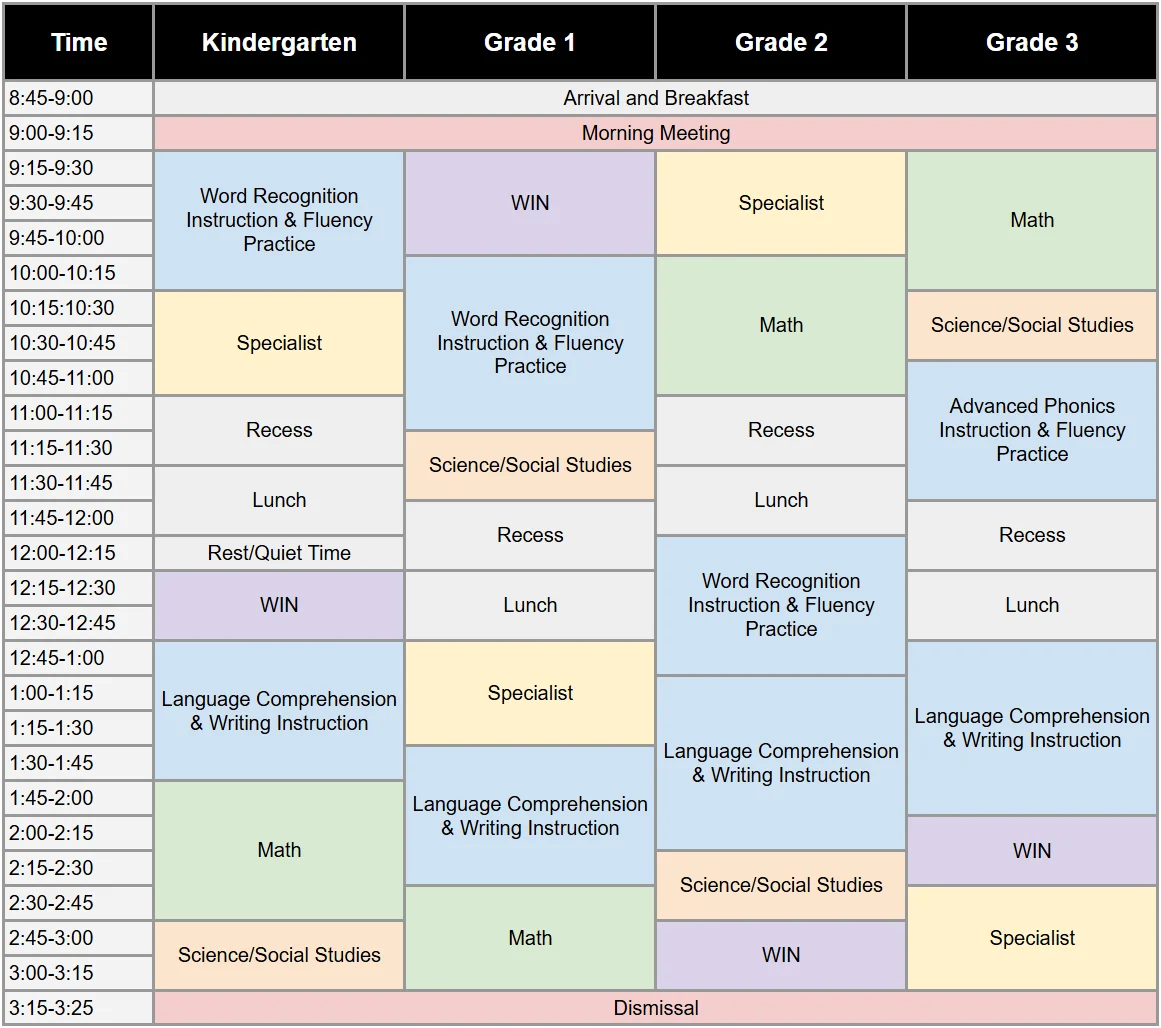
Elementary Example: Protecting Tier 1 Literacy and Embedding a Daily WIN Block
At the elementary level, leaders can use the master schedule to protect both high-quality Tier 1 literacy instruction and dedicated time for responsive support. In this example, the schedule includes protected literacy blocks organized around Word Recognition & Fluency and Language Comprehension & Writing, along with a daily WIN block that allows students to receive targeted instruction without sacrificing access to grade-level learning.
The schedule communicates instructional priorities by making time visible. Rather than protecting a single literacy block and leaving its design to chance, it intentionally allocates time for the essential components of evidence-aligned literacy instruction while preserving a separate opportunity for intervention, enrichment, and flexible grouping.
The WIN block creates the opportunity for responsive support, but its success depends on the systems that surround it. Shared expectations, flexible regrouping routines, and coordinated instructional decision-making enable educators to respond to changing student needs while maintaining strong Tier 1 instruction for every learner.
The lesson is not that every elementary school should replicate this exact schedule. Rather, this example illustrates how leaders can use scheduling as an implementation tool: protecting Tier 1 instruction, making instructional priorities explicit, and creating coordinated structures that ensure students receive the support they need.
Elementary School Example
Middle School Example: Adapting WIN Time Within a Secondary Schedule
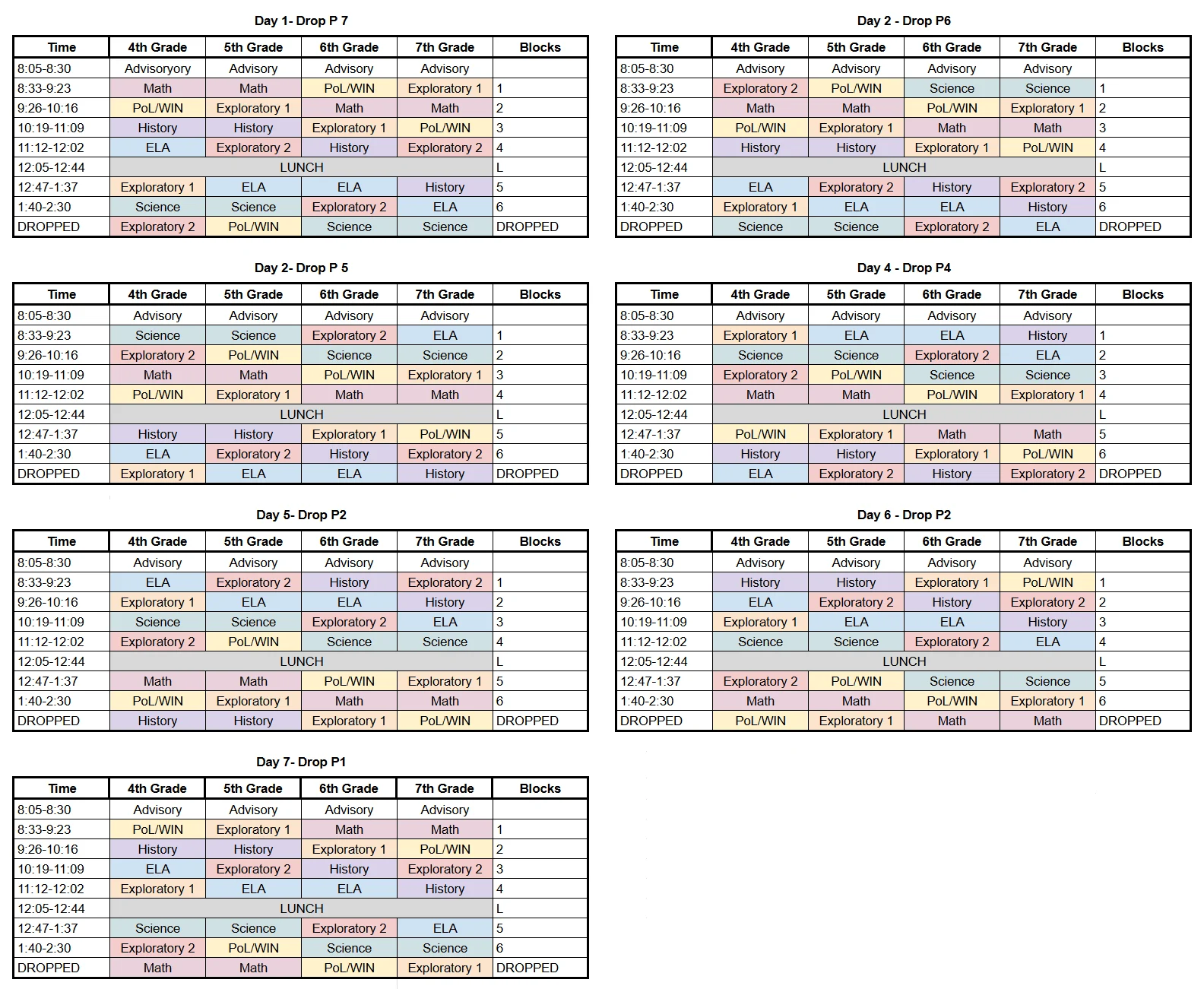
This partner district adapted its WIN approach to meet the scheduling realities of middle school. The school operates on a seven-period day with 50-minute blocks and a rotating drop schedule, where one period is dropped each day. Within this structure, students participate in a designated Portrait of a Learner (PoL)/WIN block aligned with the schoolwide Portrait of a Graduate vision.
Students participate in PoL/WIN through a cohort model, enabling educators to provide targeted support, enrichment, and skill development tailored to students’ needs. At the same time, the schedule preserves opportunities for students to participate in exploratory arts courses, ensuring that WIN does not come at the expense of a well-rounded middle school experience.
The success of this structure depends on the coordination behind the schedule: creating a predictable system within a complex schedule, establishing a clear purpose for the block, and ensuring staff share responsibility for supporting all learners.
The lesson is not that every middle school should replicate this exact schedule. Rather, this example illustrates how leaders can adapt scheduling structures to create protected time for responsive instruction while maintaining access to the experiences students need.
Middle School Example, Hoosac Valley Regional School District
High School Example: Aligning WIN Time to a Portrait of a Graduate Vision
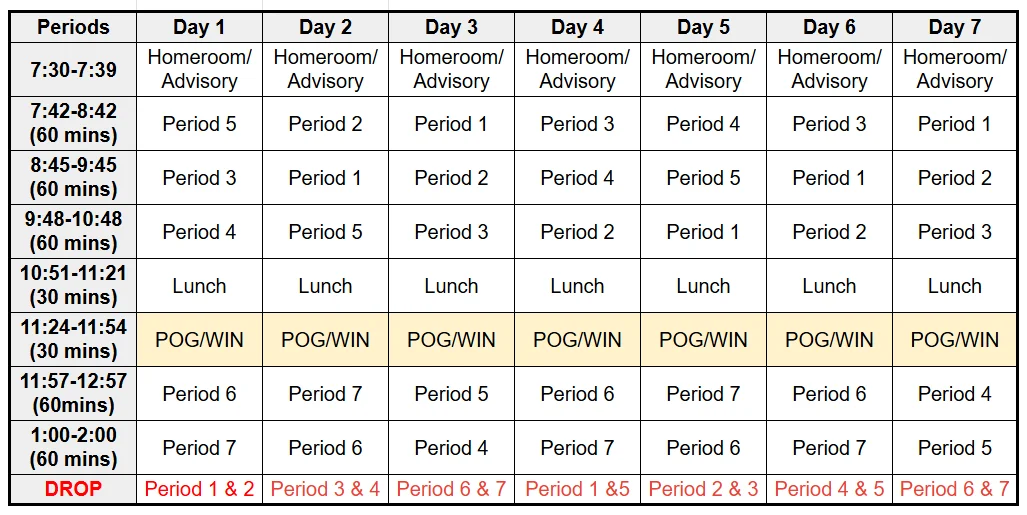
At the high school level, the same partner district continued to prioritize protected WIN time while adapting the structure to reflect the realities of a complex secondary schedule. The school operates on a seven-period day with 60-minute classes and a rotating schedule in which two periods are dropped each day. Within this structure, the school embedded a daily 30-minute Portrait of a Graduate (POG)/WIN block.
By intentionally designing the schedule to include this protected time, leaders created space for student support, enrichment, and learning experiences connected to the school’s Portrait of a Graduate vision while maintaining the credits and elective opportunities required in a high school schedule. Rather than treating WIN as an additional intervention period, the school positioned it as part of the overall student experience, providing a predictable opportunity for students to receive targeted support, pursue enrichment, and engage in learning experiences aligned to the school’s vision.
Like the elementary and middle school examples, the success of this structure depends on intentional coordination. Leaders created protected time within an existing schedule, established a shared purpose for the block, and built systems that allow educators to respond to student needs.
The lesson is not that every high school should replicate this exact schedule. Rather, this example illustrates how leaders can use scheduling as an implementation tool to create space for responsive support while advancing a broader vision for student learning.
High School Example, Hoosac Valley Regional School District
Nothing about Marcus changed in these models. He is still the same reader, with the same skill gap, in the same building. What changed was the system built around him: where his intervention time sits, who is teaching him, and how the schedule ensures he has access to both targeted support and grade-level literacy instruction. Marcus did not need less access to rich, grade-level text and discussion while he worked to strengthen foundational skills. He needed a system that provided both.
Five Questions to Ask Before You Build Next Year’s Literacy Schedule
- Where will every student receive uninterrupted Tier 1 literacy instruction?
- How will intervention be scheduled so that it supplements, rather than replaces, Tier 1 literacy instruction?
- How will staffing and expertise be deployed based on current literacy data rather than historical routines?
- When will teachers collaborate to analyze literacy data and adjust instruction?
- How will we protect the instructional minutes that matter most for literacy learning?
Final Thoughts
A master schedule will never teach a child to read. Teachers do that through evidence-aligned instruction.
But leaders create the conditions that allow evidence-aligned literacy instruction to happen consistently across classrooms. Brown and Stollar (2025) describe one of a leader’s most important responsibilities as creating the conditions that enable teachers and interventionists to align instruction with research and student data. Few leadership decisions shape those conditions more directly than the way time is organized.
A literacy schedule is not simply a collection of blocks, transitions, and staffing decisions. It’s a reflection of a school’s instructional priorities. It communicates what we believe about who deserves access to grade-level learning, how students receive support when they need it, and how we use our collective expertise to meet students’ needs.
The strongest schedules do not force a choice between Tier 1 instruction and intervention. They are designed so students can experience both rich, grade-level literacy experiences that build knowledge and language alongside targeted instruction that responds to their learning needs.
Before adopting another curriculum, purchasing another assessment, or launching another initiative, it may be worth asking a different question:
Does our schedule make evidence-aligned literacy instruction easier or harder to deliver every day?
Because every schedule already tells a story. The question is whether that story reflects the literacy priorities we say we value.
Protecting Tier 1 instruction. Aligning expertise around students’ needs. Creating time for teachers to learn from data and refine instruction. Guarding the instructional minutes that matter most. These are not separate scheduling tasks. Together, they represent the leadership work of designing a school day that makes evidence-aligned literacy instruction possible.
The master schedule is not simply an organizational tool. It is one of the clearest expressions of what a school values and one of the most powerful levers leaders have to improve literacy outcomes.
References
Brown, S., & Stollar, S. (2025). MTSS for reading improvement: A leader’s tool kit for schoolwide success. Solution Tree Press.
Education Resource Strategies. (2018). Finding time for student support in elementary schedules.
Hall, S. L. (2018). 10 success factors for literacy intervention: Getting results with MTSS in elementary schools. ASCD.
Levenson, N., & James, D. (2023). It’s time for strategic scheduling: How to design smarter K–12 schedules that are great for students, staff, and the budget. ASCD.
Little, J. W. (1982). Norms of collegiality and experimentation: Workplace conditions of school success. American Educational Research Journal, 19(3), 325–340.
Louisiana Department of Education. (2023). Staffing and scheduling best practices guidance.
Lu, A., Rouhanifard, P., Cleveland, C., Gilbert, E., & Loeb, S. (2025). The key resource of time: Master schedules and effective allocation of students and educators. SCALE Initiative, Stanford Graduate School of Education. https://scale.stanford.edu/publications/master-scheduling
Massachusetts Department of Elementary and Secondary Education. (2022). MTSS Scheduling Guidance. https://www.doe.mass.edu/csdp/guidebook/resources/mtss-scheduling-guidance.docx
Massachusetts Department of Elementary and Secondary Education. (2020). Sample Student Schedules.
National Center on Response to Intervention. (2011). RTI scheduling processes for middle schools. Washington, DC: U.S. Department of Education, Office of Special Education Programs, National Center on Response to Intervention.