In the field of adolescent literacy, secondary educators face the challenge of closing reading gaps while preparing students for increasingly complex academic demands. Structured Literacy practices are well supported by research evidence and include (a) explicit, systematic, and sequential teaching of literacy at multiple levels–phonemes, letter-sound relationships, syllable patterns, morphemes, vocabulary, sentence structure, paragraph structure, and text structure; (b) cumulative practice and ongoing review; (c) a high level of student-teacher interaction; (d) the use of carefully chosen examples and non-examples; (e) decodable text; and (f) prompt, corrective feedback (Spear-Swerling, 2018). These practices are particularly effective for students with reading difficulties, including those with dyslexia, making them essential for middle schools striving to improve literacy outcomes.
Implementation requires careful reconsideration of intervention models to accommodate older students’ specific academic and emotional needs (Fuchs et al., 2010). Secondary schools are characterized by complex schedules and diverse curricular demands that present unique challenges. However, successful implementation has the potential to streamline and enhance the existing educational practices by integrating them with a coherent, data-driven framework (National High School Center, 2010). At Bettendorf Middle School, a combination of high-quality professional learning along with integrating evidence-aligned Structured Literacy practices is providing a pathway to improving student outcomes.
The Power of Professional Learning
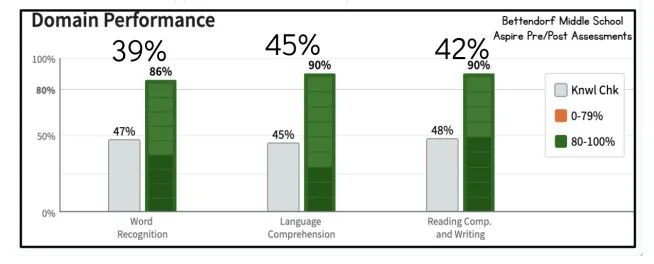
During the past 2023-2024 school year, all 6th-8th grade teachers of English Language Arts, Special Education Strategists, Academic Interventionists, Instructional Coaches, and select administrators took part in a year-long learning through Lexia Aspire. This professional development addresses reading science domains that target the middle school years, focusing on word recognition, language comprehension, reading comprehension, and writing. Each group had a tailored learning pathway designed to meet their unique instructional needs, allowing for specific skills development that supports Structured Literacy within their universal instruction and intervention settings.
Protected time was provided for teachers to engage in the program fully, and collaborative discussions enabled them to explore how to apply the Bridge to Application practices within their classrooms. Teachers noted that this professional learning fostered a deeper understanding of how foundational skills support secondary students, recognizing gaps in vocabulary and morphology instruction within their current universal instruction.
Data-Driven Interventions for Student Success
Research underscores the value of a Multi-Tiered System of Supports (MTSS) at a secondary level, yet its implementation often lags behind (Shinn et al., 2016). MTSS offers a structured, data-driven approach to providing instruction that directly addresses students’ demonstrated literacy needs. In middle schools, this should include explicit instruction and adjustments in instructional intensity, both of which significantly impact student engagement and learning outcomes (Faggella-Luby & Wardell, 2011).
Building leadership engaged in a professional learning opportunity aimed at supporting intentional and efficient scheduling practices for middle schools. It was determined that scheduled time for Tier 2 interventions would be protected for the 2024-2025 school year. Additionally, Tier 3 interventions have been structured as dedicated classes, featuring smaller group sizes and extended instructional time to allow for more intensive practice and support. Vaughn et al. (2008) found that sixth-grade students who received Tier 2 intervention outperformed those in the comparison condition on word attack, spelling, comprehension, and phonemic decoding efficiency. Implementing MTSS is essential for providing effective Tier 2 and Tier 3 interventions to support struggling readers.
For Tier 2 interventions, Bettendorf utilizes IXL, a personalized learning program that matches student needs to targeted literacy standards. IXL provides remediation, practice, and extension opportunities for each student, ensuring that interventions are closely aligned with data collected from universal screening, progress monitoring, and classroom performance. The programs utilized in Tier 3 settings include UFLI Foundations, Phonics for Reading (Levels A, B, and C), Word Connections, and Rewards Intermediate.
Addressing Pitfalls: Collaboration and Professional Growth
While initial successes are evident, challenges have emerged along the way. One key challenge was incorporating more Structured Literacy practices within existing universal instruction. After their professional learning, teachers recognized that while their standards were aligned with Iowa’s Common Core Standards, there was a need to enhance the rigor of lessons in areas such as vocabulary and morphology. To address this gap, a committee will move forward into the 2024-2025 school year by reviewing published curricula for adoption, ensuring alignment with current reading research.
Another challenge was differentiating instruction for students at varied literacy levels, particularly in content-area texts. Epsin & Foegen (1996) highlight that general outcome measures can serve as one tool for teachers to use to make informed decisions about their students’ instructional needs. They found that vocabulary is the strongest predictor of student performance, emphasizing the importance of vocabulary instruction for middle schoolers. Additionally, Vaughn and Fletcher (2012) emphasize that secondary students’ current performance and instructional needs, rather than “responsiveness to intervention” should qualify them for targeted interventions. Bettendorf Middle School has taken this finding to heart, ensuring that decisions about student support are grounded in current performance data, leading to more precise and effective interventions.
Celebrating Successes
One of the most successful elements of implementation has been the collaborative culture fostered within teacher teams. These teams meet regularly within Professional Learning Communities (PLCs) to reflect on their teaching practices, share successes, and troubleshoot challenges. This has created a space for sustained professional growth, supported by administrators and building instructional coaches who ensure that teachers receive the necessary resources, time, and support needed.
By building a community of practice, Bettendorf Middle School has fostered a school-wide culture of continuous improvement. Looking ahead, efforts will focus on refining Structured Literacy practices, enhancing universal instruction, and scaling the impact of the MTSS framework. This commitment to professional growth, collaboration, and the science of reading positions Bettendorf Community School District as a model for other schools and districts looking to improve secondary literacy. With the right tools, support, and vision, secondary literacy gaps can be closed, leading to lasting success for all students.
References
- Espin, C. A., & Foegen, A. (1996). Validity of general outcome measures for predicting secondary students’ performance on content-area tasks. Exceptional Children, 62(6), 497–514. https://doi.org/10.1177/001440299606200602
- Faggella-Luby, M., & Wardwell, M. (2011). RtI in a middle school: Findings and practical implications of a Tier 2 reading comprehension study. Learning Disability Quarterly, 34(1), 35–49. https://doi.org/10.1177/073194871103400103
- Fuchs, L. S., Fuchs, D., & Compton, D. L. (2010). Rethinking Response to Intervention at middle and high school. School Psychology Review, 39(1), 22–28. https://doi.org/10.1080/02796015.2010.12087787
- National High School Center, National Center on Response to Intervention, and Center on Instruction. (2010). Tiered interventions in high schools: Using preliminary “lessons learned” to guide ongoing discussion. Washington, DC: American Institutes for Research.
- Shinn, M., Windram, H. S., & Bollman, K. A. (2016). Implementing response to intervention in secondary schools. In Handbook of response to intervention: The science and practice of multi-tiered systems of support (2nd ed., pp. 563–586). Springer Science+Media, LLC.
- Vaughn, S., Fletcher, J. M., Francis, D. J., Denton, C. A., Wanzek, J., Wexler, J., Cirino, P. T., Barth, A. E., & Romain, M. A. (2008). Response to intervention with older students with reading difficulties. Learning and Individual Differences, 18(3), 338–345. https://doi.org/10.1016/j.lindif.2008.05.001
- Vaughn, S., & Fletcher, J. M. (2012). Response to intervention with secondary school students with reading difficulties. Journal of Learning Disabilities, 45(3), 244–256. https://doi.org/10.1177/0022219412442157
Content Disclaimer:
The Reading League Blog features a range of perspectives intended to inform and support educators, leaders, and advocates. The views expressed are those of the authors and do not necessarily reflect the positions or policies of The Reading League.