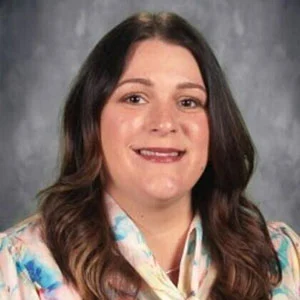
Stefanie didn’t set out to become a literacy leader. She set out to be a good kindergarten teacher. Fifteen years later, she’s an instructional coach in Indianapolis and a board member of The Reading League Indiana. Along the way, she discovered the science of reading, transformed her classroom one small change at a time, and eventually stepped out of the classroom entirely to multiply her impact. Her story is proof that one teacher willing to go first can change a lot more than just one classroom.
How It Started
Stefanie began her career as an instructional assistant, working in intervention groups and watching many different teachers before she had her own room. She started teaching kindergarten in 2010, and for the first ten years, she did what almost everyone around her was doing: guided reading, leveled texts, and the frameworks she’d been given. Then her school formed instructional leadership teams. Stefanie became a mentor teacher, and she learned there was a better way.
“I didn’t know what I didn’t know.”
Going First
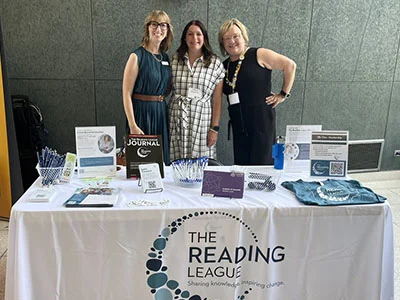 It was year ten of her career when Stefanie first heard the words “structured literacy.” Her assistant principal had a daughter with dyslexia. The school psychologist at the time (and now TRL’s VP of Marketing), Andrea Setmeyer, had been looking into the science of reading. That was enough to start a thread Stefanie couldn’t stop pulling.
She found The Reading League Indiana. She attended the Saturday morning coffee chats. She watched phonemic awareness videos, learned about sound walls, and brought the speech-language pathologist (SLP) in her building down to her room to set one up. Then she developed an explicit routine for introducing phoneme-grapheme correspondences using what she already had in her curriculum. She switched her students to decodable texts, which her curriculum already included, but everyone else was bypassing them in favor of leveled readers.
She didn’t have a new budget, nor extra professional development. Stefanie had new knowledge, and she applied it with intention.
At the end of that year, with a class of 21 students, which included students with IEPs and multilingual learners, 100% of Stefanie’s kindergarteners met the end-of-year benchmark. Her new approach was working.
She didn’t stop there. As a mentor teacher, she made a point of trying things first and proving they worked before bringing them into professional development. She understood that teachers are worn down by change that doesn’t hold, so she went first — and then brought people along.
From One Classroom to the Whole Building
Leaving the classroom to become an instructional coach was one of the hardest decisions Stefanie has made. She loved teaching. She loved the community of having her own room, seeing results up close, and knowing exactly what her students learned.
“If I have an opportunity to expand that impact beyond one classroom or one grade level, obviously I would want to help do that.”
Her first year as a coach was humbling. Building trust with teachers across kindergarten through sixth grade, including older grades she’d never taught, took time. She even pulled a small remediation group of sixth graders just to build credibility and remind herself that the science doesn’t change across grade levels—kids don’t age out of foundational skills they never learned.
When end-of-year results came in for her first kindergarten cohort, 84% of students met benchmarks — without Stefanie in the room. They did it because she had built the capacity around them.
What She’d Tell Any Educator Just Starting Out
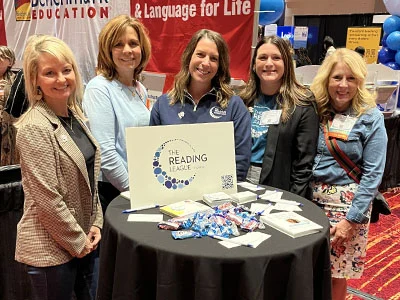 Stefanie’s advice is simple and earned: find your community, and make one small change at a time. Don’t wait until you know everything. You never will.
“You don’t have to know everything right away to start making changes in your classroom. I started with one or two things, and each year it snowballed into something else. Just do the next right thing, and find that community to support you.”
That community, for Stefanie, has been The Reading League Indiana. First, she was a member drawn in by the coffee chats and the resources she didn’t yet know she needed; then she served as a board member for four years and was committed to making sure other teachers across the state don’t have to figure it out alone.
She also offers one piece of advice that doesn’t show up in any curriculum guide: reach beyond your grade-level team. Bring in the school psychologist, the SLP, the occupational therapist, and others. Everyone in a school building is connected to reading, and the more voices you bring into the conversation, the further the work travels.
We’re grateful to Stefanie for the years she has spent going first, sharing what she’s learned, and building the kind of community that makes this work feel possible — even when it’s hard.
Your stories help bring our mission to life. If you’d like to share how The Reading League has supported your work, students, or community, we’d love to hear from you.