Turning Point: How My Son’s Dyslexia Diagnosis Changed My Practice as a Teacher

“I just feel so stupid!” My 7-year-old son sobbed as I cradled and rocked him in my lap, tears streaming down his cheeks, making wet circles on my shirt. I felt so powerless. Why couldn’t I help him? I was a teacher and yet, my son couldn’t read—and I had no idea what to do. I had tried everything I was taught. I read to him constantly from the time he was a baby. I did picture walks, surrounded him with books, asked what would make sense, practiced with flash cards. Nothing seemed to help.
I had known from the time he was little that he struggled to learn. I put a lot of thought into picking a preschool with a strong curriculum and I supplemented it with a highly recommended software program. Everything was so hard for him and I didn’t understand why. When he began kindergarten, I voiced my concerns to his teacher right away. She wasn’t worried at first, but eventually he was tested for special education. An IEP was written and signed in May of that year. Relieved, I thought we would finally start to see some progress. But almost two years went by and he continued to fall further and further behind. He went to resource every day, but the gap was only growing wider.
“I was a teacher and yet, my son couldn’t read—and I had no idea what to do. I had tried everything I was taught.“
And now here we were in the spring of his 2nd grade year. His misery was becoming hugely apparent. I needed to do something. I needed answers.
I decided to take him to a neuropsychologist for testing and was stunned at the results. He had severe dyslexia, dysgraphia, and dyscalculia. I asked for clarification. Just how bad was it? What exactly did “severe” mean? The neuropsychologist told me that my son was in the first percentile, meaning that 99% of his nationally-normed peers scored higher than he did. The most troubling diagnosis came next—depression. When the doctor had asked my son if he was happy, he solemnly replied, “Not very much.” As a mother, this was excruciating to hear, but it also rang true. He had frequent meltdowns at home, he cried when he had to do homework, he even cried in school. He trudged to and from class with a grim look of defeat on his face. “He just seems so sad,” one teacher remarked.
The year my son was diagnosed was also the first year I taught kindergarten. I had previously taught 2nd grade and was excited for this new challenge. I soon found that teaching kindergarten students to read was incredibly frustrating. We spent a lot of time practicing letter names and sounds. Despite spending so much time on letter-sound instruction, the books that we were given to practice reading in small groups came from a big box program, and the words in the books did not reinforce what we had been teaching our students. I had been so excited to show them that knowing letters and sounds would help them read. Instead, those books required me to tell students to stop sounding out the words.
“My students would read their books by using context clues, pictures, and thinking about what would make sense, as I instructed them to do. The damage these cueing habits caused was never apparent to me until I was teaching kindergarten.“
I felt as though I had to ask them to throw everything they had been learning out the window. “Oh, this word you can’t sound out.” “Uh, look at the picture. Does it give you a clue?” I was so frustrated that the words in these books could not be read without me providing their repetitive sentence patterns or instructing them to look at the pictures for cues. I hated that students weren’t putting their letter-sound knowledge to use. I hated that they were basically going through the motions of “reading,” but really just guessing.
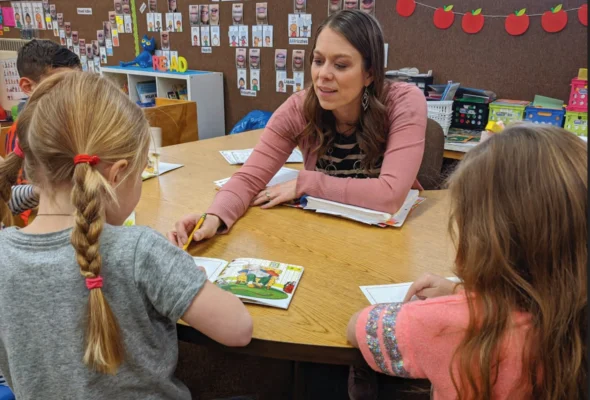
I had used balanced literacy approaches and these same cueing prompts when I taught 2nd grade. My students would read their books by using context clues, pictures, and thinking about what would make sense, as I instructed them to do. The damage these cueing habits caused was never apparent to me until I was teaching kindergarten. This wasn’t reading! I wanted my kindergarten students to practice their letter sounds. I wanted to show them how they could put those individual sounds together to make words. I wanted them to apply all the phonemic awareness and phonics knowledge they had gained. I wanted them to decode. Instead, I was giving them a false idea of what reading was.
That same year, I had a student who struggled severely. By the end of the year, she had learned only a few letters. I was unsure how to help her. I remember placing a book in front of her as I administered our state-mandated end-of-year kindergarten test. She vaguely looked at the words on the page and then studied the picture. She looked back down at the words and found the word “I.” Then she looked at the picture again and said, “I like the dog.” She turned the page and continued in the same fashion. She “read” the whole book perfectly, even though she only knew a few letters and sounds. I knew she could not really read, but she certainly gave the appearance of reading. I began to grow uneasy about the reading methods I had been taught.
Between my son’s diagnoses and these experiences with my kindergarten students, I began to question everything. I began to think. Dyslexia? Isn’t that where people see things backwards? What exactly is it? As I began to investigate dyslexia and ponder my teaching methods, things began to click. I became obsessed with getting my hands on every book imaginable: Kilpatrick, Moats, Seidenberg, Henry, Shaywitz, Birsch, Eide, and Wexler. I couldn’t stop reading! I felt like a starved animal. I couldn’t get enough. All my workouts at the gym turned into mini PD sessions: I watched videos of The Reading League’s Live Events, lectures on phonics and explicit instruction on YouTube, Orton-Gillingham demonstrations, and more.
The more I learned, the angrier I became. Why was I never taught about dyslexia? It is the most commonly diagnosed learning disability, yet it’s barely mentioned in teacher prep programs or in schools’ professional development offerings. I was a certified teacher, and yet I knew nothing about it. Why was I never taught about the National Reading Panel? Why was I never taught about structured literacy? Why was I never taught about explicit, systematic phonics and phonemic awareness? Why wasn’t I told there was an approach that could reach ALL learners and not just the top 40%? Why aren’t teachers given this vital information? I felt betrayed. I felt misled. Who are the proponents of balanced literacy and why are they promoting it? Why is the science of reading being largely ignored?
“Why wasn’t I told there was an approach that could reach ALL learners and not just the top 40%? Why aren’t teachers given this vital information?“
Armed with this knowledge, I began my second year of teaching kindergarten in a much different way. I was bound and determined to teach more explicitly and systematically. I wrote a grant for high-quality decodable books, removing predictable texts from my classroom. I asked my principal to purchase a phonemic awareness curriculum and she graciously agreed. There was no more guessing from pictures, no more guessing from context clues, no more coding running record errors with an M, S, or V. I continued to build my knowledge by taking a 5-day training in structured literacy.
I began applying all the things I was learning in my classroom. And my students responded. Even the students with the most difficulty in my class began learning to read well. I recall one student literally shouting, “Mrs. Kemeny! I’m actually reading the words!” His joy and excitement were overflowing. My students felt so much confidence and success, and our reading scores began to climb.
District leaders noticed my improved scores and asked to observe my classroom. After showing them the phonemic awareness curriculum I was using, several other schools in the district began adopting it. I was asked to present at our district summer conference and share my newfound knowledge with other teachers. I gave presentations to the rest of the faculty and was even invited to speak at a reading summit in my state.
During all of this, I also began working intensively with my son. Shocked to find that his special education teachers were not trained in dyslexia or the science of reading, I began to take over the responsibility of teaching him to read. I worked with him each day. We started at the end of his 3rd grade year, continued throughout the summer, and now continue in 4th grade. As his reading steadily improves, so does his self-esteem. He is not only coming to terms with his disabilities, he is embracing them. The fractures in his heart are healing and his confidence is growing.
But I will never forget the day that my son looked me in the eyes and said, “I wish I was one of those babies that got left in a hot car.” It took my breath away. I couldn’t fathom the depths of his pain. The ability to read is so tightly connected to how people feel about themselves. It is also closely connected to how our society views intelligence. The pressure is often too much on children like my son. I visited a classroom in my district where a 3rd grade boy always kept his head down on his desk and refused to do anything. When he was approached by an adult, he would lift his head and repeat, “I’m illiterate. I’m illiterate.” Then he would put his head back down. He had completely shut down. This is what happens to these students. They are shutting down. Every day they are forced to be in an environment that constantly reminds them they are failing. Most well-intentioned teachers have no idea how to help them. The gap gets wider and wider, causing their self-esteem to plummet lower and lower. They feel lost and forgotten. They trudge through the school system, haunted by feelings of inadequacy and worthlessness.
“Many things are helping my son’s depression, but I have come to realize that what is helping him the most is the ability to read. We greatly underestimate the impact reading can have on building resilience in children.“
We know students like my son are not broken, and we know that, just like my son, there is hope for them. Many things are helping my son’s depression, but I have come to realize that what is helping him the most is the ability to read. We greatly underestimate the impact reading can have on building resilience in children. Dr. Don Meichenbaum, a psychotherapist and expert on trauma, noted that one of the characteristics of resilient children is academic competence, especially in reading and math (Meichenbaum, 2018). Expanding on this, the most powerful thing we can do for traumatized children, as teachers, is to teach them to read (Dykstra, 2018). We have the ability and obligation to provide this for our students.
It takes a lot of courage to take a hard look at our instruction to determine if the way we are teaching is effective for all of our students. Yet I see examples of teachers doing this all over the world, and I am bolstered by their examples. They are turning their backs on the ineffective reading strategies they have been taught. Sometimes it is hard when you feel alone and it can be frightening to speak up. But just know that there are thousands of educators alongside you, cheering you on and supporting your efforts. I know that we can help our discouraged learners and I have gradually recognized that my reach can extend beyond the four walls of my classroom. So yes, I will share, I will write, I will speak, I will present. And, oh my, will I teach! Our students deserve it.
References
Dykstra, S. (2018, February 3). A developmental model of trauma, growth, and resilience: The place for language and reading [Video]. YouTube. https://www.youtube.com/watch?vkovadVljoPA
Meichenbaum, D. (2018, May). The nature of the challenge: Incidence and impact of trauma and implications for interventions [Paper presentation]. Melissa Institute 22nd Annual Conference, Miami, FL, United States.
Written by: Lindsay Kemeny
Content Disclaimer:
The Reading League Blog features a range of perspectives intended to inform and support educators, leaders, and advocates. The views expressed are those of the authors and do not necessarily reflect the positions or policies of The Reading League.