Nuestro Mundo Public Charter School is a 100% free, public school open to students in Providence, Rhode Island. Nuestro Mundo serves students in grades Kindergarten through 8th. Nuestro Mundo’s enrollment is selected via blind lottery, but weighted to ensure a minimum of 50% dominant Spanish speakers.
The mission of Nuestro Mundo is to prepare students to be global citizens and stewards of our environment. Using a multilingual and multicultural lens, our students have the knowledge and skills to realize empathy and connect with a larger global audience.
The curriculum goes beyond academics, emphasizing environmental awareness and multicultural education to foster well-rounded, compassionate and capable students. By addressing global issues like climate action and social inequality, we prepare our students to actively contribute to their communities and navigate the challenges of our world.
Nuestro Mundo is a dual language two-way immersion school that aims to serve multilingual learners and students whose first language is Spanish. The current student population of the school is 81% Hispanic, 6% African American, 2% American Indian and 11% White.
Nuestro Mundo’s language allocation model is 50/50, meaning half of the instructional time is spent teaching content through the Spanish language and half teaching content through English, focusing on building literacy skills in both languages with explicit instruction in metalinguistic awareness.
When the school opened in 2021, the goal was to be an exemplary dual language school in the city, state, and region. As I wrote and rewrote the curriculum section of the application, I drew upon resources from my time working at MABE, The Principles of Dual Language Education, and Responsive Teaching.
Once the doors opened with a brand new staff with little to no dual language experience, administrators that were tied down with creating new systems from scratch, including a curriculum that did not reflect the latest research in dual language, nor foundational reading skills comprehensive of the unique characteristics of the phonetic systems in each the Spanish and English alphabets.
After advocating for a balanced literacy system to include reading, writing, comprehension strategies and vocabulary acquisition, we realized many students needed more structured and explicit reading instruction. As complicated as the English phonetic system is, students flourished when given more focus on phonics, phonic decoding, encoding, decodable texts, morphology, syntax, and semantics. We found we had to bolster these skills using the components of a new program, Intelexia.
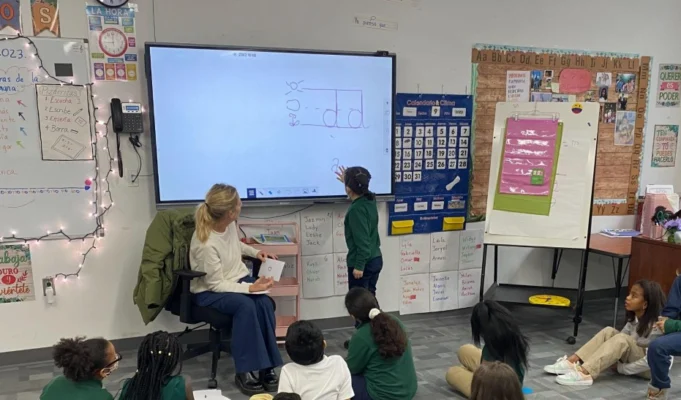
To set our students up for success in biliteracy, we enrolled in an Intelexia training that developed educator knowledge in the science of reading and structured literacy both in English and in Spanish. We also spoke to other dual language schools on their reviews of our Tier I curriculum, American Reading Company. We now draw upon the rich resources from the American Reading Company, like their authentic thematic texts in English and Spanish for read alouds and independent reading. However, K-2 teachers can focus on the explicit and systematic foundational reading skills that were stronger in our more recently adopted foundational skills programs, PAF and Aprendo Leyendo. As they move from one book to the next book at a higher level, the class celebrates together. They have a tangible artifact of their progress in reading that they achieve and get excited about together. Intelexia incorporates all the components of building early literacy skills that are mentioned above, and significantly improved our students’ ability to develop accurate and automatic word reading skills in both English and Spanish, which boosted their confidence.
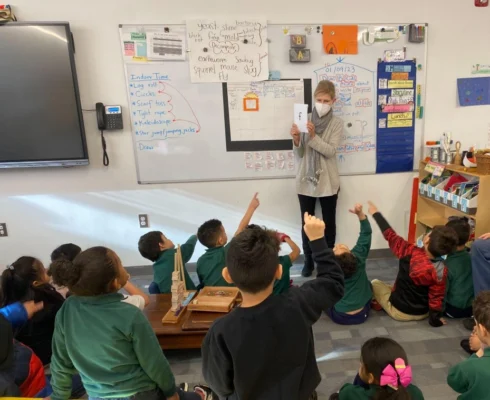
Future work is centerint on embracing the newest research in translanguaging working with an Multilingual Learner success grant to create space for students to compare the phonics, decoding and encoding skills across languages to build strong metalinguistic connections.
We look forward to sharing our success this year!
Written by: Katie Cardamone
Content Disclaimer:
The Reading League Blog features a range of perspectives intended to inform and support educators, leaders, and advocates. The views expressed are those of the authors and do not necessarily reflect the positions or policies of The Reading League.