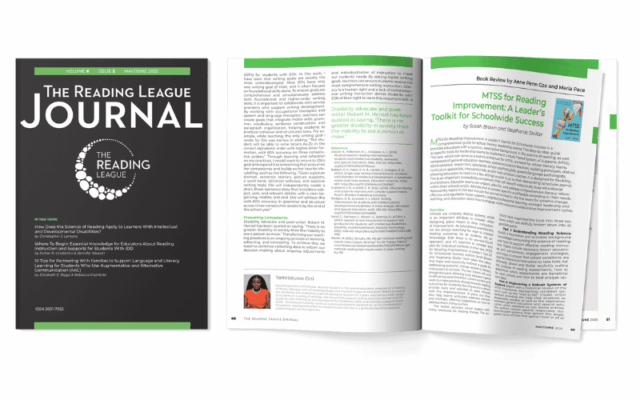
The Reading League Journal is a trusted source guiding educators in adopting evidence-aligned instruction. TRLJ features articles that translate scientific evidence about reading into easily understandable and applicable strategies for professionals in the field. Additionally, it includes articles spotlighting school systems and educators who have effectively applied research findings to improve and transform their practices. TRLJ is published in January/February, May/June, and September/October.
Meet our Editor-in-Chief: Dr. Jessica Toste
Choose Your Subscription
Select the subscription model that best supports your professional needs—whether you’re deepening personal expertise, equipping a team, or expanding institutional access to evidence-aligned literacy research.
Already a subscriber? Manage Your Account
Sneak Peek Articles
Jessica R. Toste, Daniel Espinas, Eric Oslund, Amy Elleman, and Gina Biancarosa
Jan/Feb 2026 – Table of Contents
Teaching is a bit like navigation—continually adjusting course based on student progress, needs, and an evolving classroom context. Every instructional decision, at its core, is a hypothesis about how students learn, and assessment data provide the evidence needed to test and refine those hypotheses.
Esther R. Lindstrom and Jennifer Stewart
May/June 2025 – Table of Contents
As Structured Literacy instruction and the science of reading build momentum in schools, educators may wonder about how these approaches apply to students with intellectual and developmental disabilities (IDD).
Alisha Nicole Demchak and Emily Solari
Jan/Feb 2025 – Table of Contents
Alphabet knowledge is essential for children’s future reading and writing and represents one of the most important early childhood emergent literacy skills.
Lindsay Young and Lindsey Chapman
Sept/Oct 2024 – Table of Contents
Recent federal and state initiatives have renewed the call for evidence-based reading instruction grounded in the science of reading, and the effects of these efforts have largely centered on early literacy in elementary grades.
Maya Valencia Goodall, Marisa Gomez, and Dale W. Webster
May/June 2024 – Table of Contents
Over the past quarter-century, national awareness of multilingual learners (MLs)—particularly those with emergent English proficiency, federally known as English Learners (ELs)—has steadily grown.
Brenda Warren
Jan/Feb 2024 – Table of Contents
Low literacy profoundly impacts the health and well-being of children and the adults they will become.
Christy Austin, Liz Stevens, Alisha Demchack, and Emily Solari
Sept/Oct 2023 – Table of Contents
“The Orton-Gillingham Approach (OG) is a direct, explicit, multisensory, structured, sequential, diagnostic, and prescriptive way to teach literacy when reading, writing, and spelling do not come easily to individuals, such as those with dyslexia.”
Ramona T. Pittman, Marianne Rice, Esther Garza, and Myriam J. Guerra
May/June 2023 – Table of Contents
The National Reading Panel (2000) identified phonemic awareness as one of the pivotal pillars in teaching students to read.
Christopher Schatschneider, Dana Santangelo, Christine M. White, Cristian E. Vasquez, and Emma D. Friedmann
Jan/Feb 2023 – Table of Contents
What is the science of reading? The Reading League, in their document “Science of Reading: Defining Guide” (TRL, 2022), proposes that “the science of reading is a vast, interdisciplinary body of scientifically-based* research about reading and issues related to reading and writing.”
Rebecca Gotlieb, Laura Rhinehart, and Maryanne Wolf
Sept/Oct 2022 – Table of Contents
For decades, while loving adults have read children rhymes like Humpty Dumpty and tales of fairies and heroes, researchers from multiple areas have sought to understand how the human brain ever learned to read, why it sometimes doesn’t, and how this collective knowledge can help all children learn to read wisely and well.
Dena Mortensen
May/June 2022 – Table of Contents
“So, how do we teach reading?” I asked this loaded question as a new teacher 22 years ago. As it turns out, the answer is complex—in fact, it is “rocket science” (Moats, 2020).
Hugh W. Catts
Jan/Feb 2022 – Table of Contents
Proficient reading comprehension is a major goal of early literacy instruction. At the end of each school year starting in third grade, students are given a standardized test of reading comprehension.
Isabel Vargas, Colby Hall, and Emily Solari
Sept/Oct 2021 – Table of Contents
English learners (ELs) are the fastest growing population of students in the United States. There are over 4.8 million ELs enrolled in K-12 schools.
Emily Solari, Yaacov Petscher, and Colby Hall
May/June 2021 – Table of Contents
A recent meta-analysis published in Exceptional Children (Stevens et al., 2021) looked at the effects of Orton-Gillingham (OG) reading interventions on reading outcomes for students who have word reading difficulties.
Emily Solari, Colby Hall, and Anita McGinty
Jan/Feb 2021 – Table of Contents
Most educators understand that early intervention is important for the prevention and/or remediation of word reading difficulties. But how did we come to know this?
Interview
Sept/Oct 2020 – Table of Contents
Timothy Shanahan is Distinguished Professor Emeritus at the University of Illinois at Chicago. Previously, he was director of reading for the Chicago Public Schools.
David A. Kilpatrick
May/June 2020 – Table of Contents
“To clarify the role of decoding in reading and reading disability, a simple model of reading is proposed, which holds that reading equals the product of decoding and [language] comprehension.”
Article Submission
Do you have a passion for sharing knowledge and best practices in the science of reading? The Reading League Journal (TRLJ) features articles written by researchers and educational practitioners like you. Our authors contribute to the advancement of the science of reading and teaching.
- Researchers: Review and present scientific studies in a format that is meaningful for educational professionals.
- Educational Practitioners: Share insights and experiences in implementing scientific research into practice.
Please note that we do not include original research reports or descriptions of classroom practices that do not directly apply scientific findings.
TRLJ aims to feature high-quality contributions around timely and significant topics, fostering deeper dialogue between scholars and practitioners. To meet this aim and expand our reach, TRLJ has introduced thematic issues as of our spring 2025 issue. With our shift to thematic issues, TRLJ will be limiting unsolicited manuscript submissions to ensure a more focused and curated approach to publication. This change will allow us to be intentional in selecting articles that align with each issue’s theme while maintaining the journal’s rigorous standards. Please email Dr. Toste if you have questions about a future submission.
If you have been invited to submit an article to TRLJ, please view our Author Guidelines to ensure that your work aligns with our established criteria.
Additional Information
Questions?
For questions regarding payment, subscription status, and address changes please call toll-free at 844-967-0615 or email the Journal customer service department at: readingleaguecs@emailpsa.com
Customer Service
Customers looking to purchase The Reading League Journal using a purchase order, please email your PO documents and payment to readingleaguecs@emailpsa.com or mail to:
The Reading League Journal
℅ Publishers Service Associates
PO Box 162681
Altamonte Springs, FL 32716-2681
Advertising Opportunities
For advertising opportunities, please contact Toni Ann Walsh at toni@thereadingleague.org.
